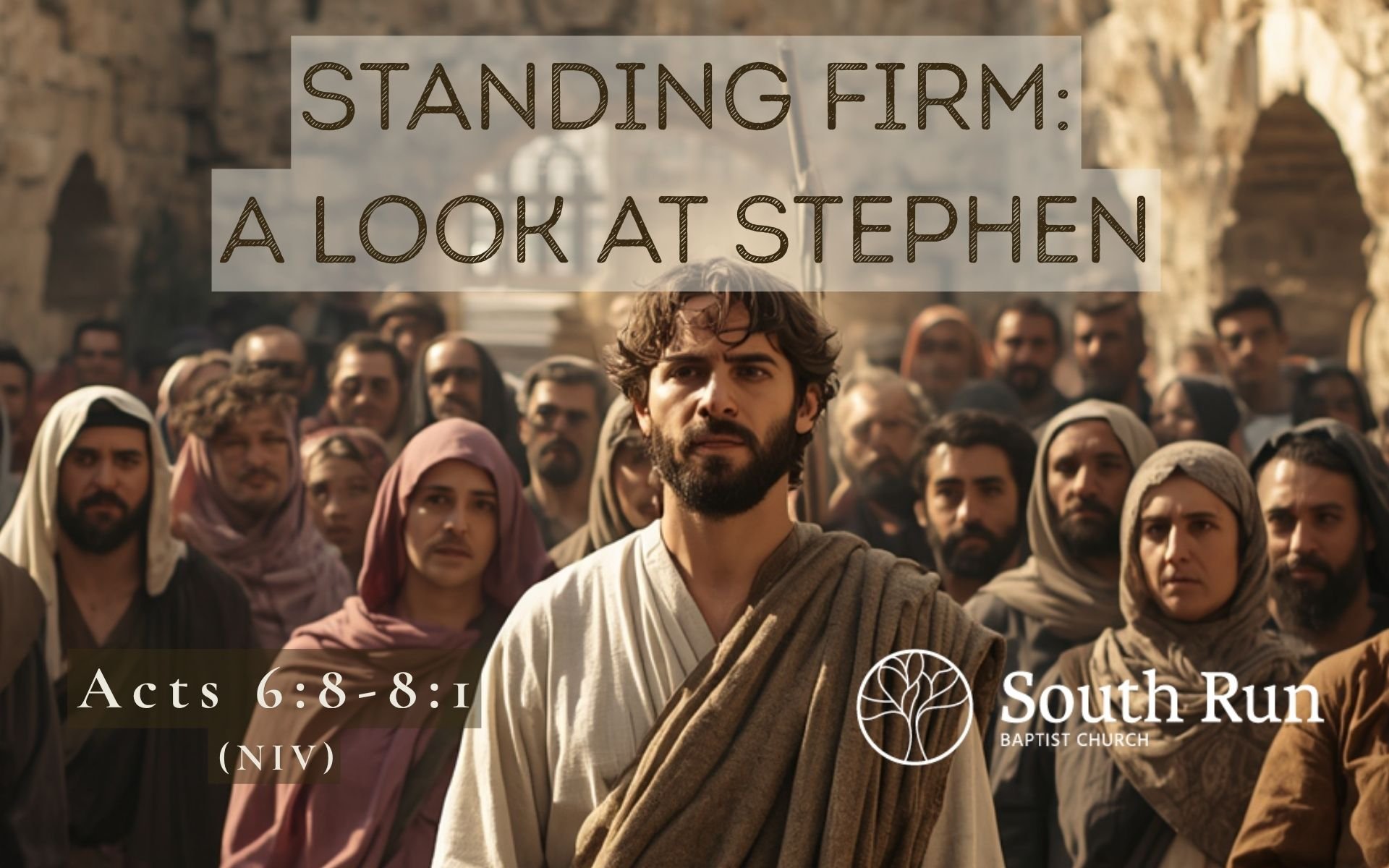
Standing Firm: A Look at Stephen

Deen Salami | Guest Pastor Standing Firm: A Look at Stephen

Check out the weekly sermon here or on our SRBC podcast on Apple Podcast and Spotify. While you’re at it, check us out on Facebook and Instagram too.

Like what you hear? We’d love to know.

At South Run, we read every message personally. Whether you have a question, want to share how God is moving in your life, or are thinking about visiting in person, this is the place to start. If you click the link below, Pastor Eric will personally reach out to you.

  • Standing Firm: What Stephen's Martyrdom in Acts 6–7 Teaches Us About Faith Under Fire — Sermon Transcript

    South Run Baptist Church | Springfield, VA

    Guest Preacher: Deen Salami

    Acts 6:8–7:60

    June 7, 2026

    This is a full sermon transcript from South Run Baptist Church in Springfield, Virginia. In this message, guest preacher Deen Salami preaches on the martyrdom of Stephen from Acts 6–7. This sermon addresses how Stephen — an ordinary believer full of faith and the Holy Spirit — stood firm against hate and persecution before the Sanhedrin, what his conduct, his defense, and his death reveal about the cost of following Jesus, and why the church's first martyr was not a tragic accident but a catalyst for the spread of the gospel.

    Opening: A Passage That Can Almost Preach Itself

    I am a little excited today about the message. We've got a lot of ground to cover. There's a large section of scripture that I want us to go through. I'm going to act as your guide. It's not very often that there are passages of scripture that actually can preach themselves. This passage just might be one of them. So what I'd like to do is just to act as your guide. I'll read through big chunks of scripture and I'll just make a couple of observations for us to consider as we do. To do that, though, I'll only need about another hour. Are you guys good with that? I know better than to get in the way of lunch, so I'll make sure that I'll get through this thing in a reasonable amount of time, and I promise we'll survive the experience, all right?

    All right, why don't you join me in prayer? Gracious God and Father, behold this time. It is you who have called all these people here. None are here by accident. You have assigned me to this task for this day and this hour, and I just pray, Lord God, that you would act and move. Empower now your servant to be able to bring forth this majesty for your people's benefit and for the glory of your great name. May everything that be said and done would be pleasing to you. We pray all of this in Jesus' name. Amen.

    Context: Who Was Stephen, and Why Does He Matter?

    Now, we've already had the first section of our passage read to us. We're going to look at the first martyr of the early church. If you guys know, that is a follower by the name of Stephen. Before he was crucified, Jesus warned the disciples that the world would hate them because of him, and as a result, they would suffer persecution. So how do we stand firm against the hate and persecution? Well, Stephen is going to help us answer that question because he experienced exactly what Jesus said he would. How he handles the hate is a great example for us to follow.

    Now, again, we've already read that first section in Acts 6:1–8, but as we go into the commentary of it, I want you to consider three simple things: the charges brought before Stephen, his conduct throughout this whole trial, and what it costs him at the end. Three things — charges, his conduct, and the cost.

    The gospel was being preached early on. It's the early part of the church's existence. The gospel was being preached, and after an early reception by the masses, opposition began to rise, specifically from the religious leaders. Stephen was a Hellenistic Jew, which means that his native tongue was not Aramaic, but it was Greek. He was also a Diaspora Jew, meaning that he was not born and raised inside Israel proper. He was born and raised outside of Israel. He came to Jerusalem, heard the gospel, and became a believer. He was not one of the original 12. He had no special place of prominence. In fact, when we first learn of Stephen a few verses earlier, he was in charge of food distribution for the church. In other words, Stephen was a simple, normal person, just like any one of us. His only desire was to serve and to be used by God.

    Now look at how he was described in this section. It says that he was full of God's grace and power, and he performed great signs and wonders. Up until this point, that description was only made of the apostles. But he ran into his fellow Diaspora Jews, and they could not withstand him in debate, because the Spirit of God had given him great wisdom. Since they were unable to defeat Stephen in debate, they slandered him, brought him up on trumped-up charges, and dragged him before the Sanhedrin. And this, by the way, is the third time that a follower of Jesus was dragged before the Sanhedrin. The first time it was Peter and John for healing a lame man. But because the crowds were praising God, they let them go. The second time was with all 12 apostles. They were beaten and sternly warned no longer to preach the gospel. This time, the Diaspora Jews were mobilized as a mob against Stephen, and if you were hearing properly and paying attention, you noticed that Stephen is alone. Incidentally, this is the same council that sentenced Jesus to death.

    The Charges Against Stephen: Disrespecting Moses and the Temple

    So let's hear the charges brought against Stephen. It was the disrespect of the law — which is referred to as Moses — and the disrespect of God, the temple, because they believed that God's presence was in the temple. But Stephen is going to take these two charges and turn them on his accusers.

    But for now, I want to draw your attention to how Luke describes Stephen as he stands before the Sanhedrin. He says that he has the face of an angel. Now, I doubt very much that the Sanhedrin thought Stephen was hot, right? But what is it that made his appearance unmistakable? The question I want us to consider is, how is it possible that a normal person like Stephen — who was not part of the inner circle of Jesus — is able to do the things that Stephen had done and was described the way Luke describes him?

    Acts 6:5 — Full of Faith and the Holy Spirit: What That Actually Means

    And I believe that the answer is found in verse 5 of chapter 6. This is the very first description we have of Stephen: he's a man full of faith and the Holy Spirit. But the question is, what does that mean exactly?

    Let me start with full of faith. Because there are three aspects of faith that we see in Stephen. First, there's an intellectual determination. What do I mean by that? It simply means that he's asking himself, is the gospel true, and do I believe it? Am I a sinner, like the gospel says, and do I need a Savior, the Lord Jesus Christ? Stephen's answer is yes. The second is, do I trust Jesus? Will I submit my life to him and proclaim him as my Lord? Again, Stephen answers, yes. But finally, will I commit everything to him, even if it means my death? And as we will see, Stephen will answer that question yes as well.

    But let me ask us all a question here. How are we doing in these three aspects? For most Christians, they're okay intellectually up here. Do I need a Savior? Yes. But it's the other two that they stumble at. Is he actually Lord? Am I running my own life? Do I just need Jesus as an advisor — I'll call on him when I need to? Or is he actually Lord? Do we actually commit our lives to him, willing to die?

    Because Stephen was all in with Jesus, it gave the Holy Spirit free reign to use Stephen any way he wanted. Not like a puppet, but as an active and willing partner in the work of advancing the kingdom. It's like the Fellowship of the Ring. Do you guys remember the Fellowship of the Ring? Remember when Frodo said he was going to go and take the ring to Mordor? Aragorn said to him, if by my life or death I can protect you, I will. Why? Because the fate of Middle Earth hung in the balance, right? But for us today, it's the souls — the eternal souls of people — that hang in the balance. And the only hope for them is Jesus Christ. Amen? If by our life or death, if we have the opportunity to advance the gospel of Jesus Christ, will we? Are we all in like Stephen, full of the Holy Spirit?

    What the Sanhedrin saw in Stephen was the very presence of the divine emanating from him. But let's move on and see what happens next.

    Acts 7:1–16: Stephen's Defense Begins — Summarizing Genesis 12 Through Exodus 1 from Memory

    I'm going to read from chapter 7, verse 1. "Then the high priest asked Stephen, are these charges true? To this he replied, brothers and fathers, listen to me. The God of glory appeared to our father Abraham while he was still in Mesopotamia before he lived in Haran. Leave your country and your people, God said, and go to the land I will show you. So he left the land of the Chaldeans and settled in Haran. After the death of his father, God sent him to this land where you are now living. He gave him no inheritance here, not even enough ground to set his foot on. But God promised him that he and his descendants after him would possess the land, even though at that time Abraham had no children. God spoke to him in this way, for 400 years your descendants will be strangers in a country not their own, and they will be enslaved and mistreated. But I will punish the nation they serve as slaves, God said, and afterward they will come out of that country and worship me in this place. Then he gave Abraham the covenant of circumcision, and Abraham became the father of Isaac and circumcised him eight days after his birth. Later, Isaac became the father of Jacob, and Jacob became the father of the twelve patriarchs. Because the patriarchs were jealous of Joseph, they sold him as a slave into Egypt. But God was with him and rescued him from all his troubles. He gave Joseph wisdom and enabled him to gain the goodwill of Pharaoh, king of Egypt. So Pharaoh made him ruler over Egypt and all his palace. Then a famine struck all of Egypt and Canaan, bringing great suffering, and our ancestors could not find food. When Jacob heard that there was grain in Egypt, he sent our forefathers on their first visit. On their second visit, Joseph told his brothers who he was. And Pharaoh learned about Joseph's family. After this, Joseph sent for his father Jacob and his whole family, 75 in all. Then Jacob went down to Egypt where he and our ancestors died. Their bodies were brought back to Shechem and placed in the tomb that Abraham had bought from the sons of Hamor at Shechem for a certain sum of money. And as the time drew near for God to fulfill his promise to Abraham, the number of our people in Egypt had greatly increased. Then a new king, to whom Joseph meant nothing, came to power in Egypt. He dealt treacherously with our people and oppressed our ancestors by forcing them to throw out their newborn babies so that they would die."

    Now, for those of you who may have picked up on it, Stephen just summarized Genesis 12 all the way through Exodus 1. Genesis 12 is where we have God's promise to bless the world through Abram. Stephen starts there and ends in Exodus chapter 1. That is approximately 39 chapters that he summarized from memory under pressure. Now, if you were on the Sanhedrin, what would you be thinking right now about the charge of disrespecting the law? At least at this point, it looks like that charge is on kind of shaky ground. In fact, some of the Sanhedrin might be looking at Stephen and secretly giving him a thumbs up. Way to go, bro. Good job, all right?

    Why Stephen Uses Geography and the Stories of Joseph and Moses Strategically

    What I don't want you to miss, though, is how Stephen is telling this story. I want you to notice the way Stephen is making use of geography — Mesopotamia, Haran, Israel, Egypt. He is summarizing what God did in those places, but why is he doing this? Also, I want you to keep in mind what he says about Joseph and his brothers. I'm going to develop that here in a minute. Just be patient, okay?

    Now, before we move on, I want to highlight how Stephen addresses his adversaries. To the mob, he refers to them as brothers. To the Sanhedrin, he refers to them as fathers. This mob who dragged him forcefully before the Sanhedrin, and this council that not only sentenced Jesus to death but beat the 12 apostles — the question on the table is, why is Stephen so cordial?

    A few observations. First, he does not seem to be taking their behavior toward him personally. The moment is not lost on Stephen. He's acutely aware of the danger he is in, but he remembers his mission, which was the same as Jesus. He does not want to condemn them. He wants them to know the truth. So he speaks to them in a way fitting that purpose. He does not retaliate against them for mistreating him.

    Second, Stephen understands that their behavior is symptomatic of a bigger issue. He knows what the Apostle Paul will later go on to understand and share with Timothy. As we read in 2 Timothy 2:25–26, Paul says this: "Opponents must be gently instructed in the hope that God will grant them repentance, leading them to a knowledge of the truth, and that they will come to their senses and escape the trap of the devil who has taken them captive to do his will." Stephen understands that these people have been taken captive by the devil so that they would do his will. But Stephen hopes that they will come to their senses. So he begins by instructing them gently. And in his approach, Stephen is reflecting the very heart of God. Back in Ezekiel 33:11, we hear God say this: "As surely as I live, declares the sovereign Lord, I take no pleasure in the death of the wicked, but rather that they turn from their ways and live. Turn, turn from your evil ways. Why will you die, people of Israel?" Stephen does not clap back at them.

    Third, he is gentle because he is focused. He knows it's not about him. This encounter is much bigger than Stephen, and he is keenly aware of it, and we can tell by the way he conducts himself.

    It's a powerful lesson for us today, isn't it? If we're going to stand firm against hate and persecution, we will resist the urge to take people's behavior toward us personally. We remember that their behavior is symptomatic of a bigger issue. They are captives of the devil, and what we want to stay focused on is our mission to be active agents in freeing them through spreading the gospel of Jesus Christ.

    Now one last point before we move on. We are 19 verses into Stephen's speech and in all his words, Stephen is not trying to defend himself. He has not yet answered the question that was put before him: are these charges true? He hasn't quite answered that question, at least not directly.

    Acts 7:20–43: Moses, the Burning Bush, and the Pattern of Rejected Messengers

    But let's get back to the rest of Stephen's speech, because I think we'll find some more for us to consider.

    "Now at that time, Moses was born, and he was no ordinary child. For three months, he was cared for by his family. When he was placed outside, Pharaoh's daughter took him and brought him up as her own son. Moses was educated in all the wisdom of the Egyptians and was powerful in speech and action. When Moses was 40 years old, he decided to visit his own people, the Israelites. He saw one of them being mistreated by an Egyptian, so he went to his defense and avenged him by killing the Egyptian. Moses thought that his own people would realize that God was using him to rescue them, but they did not. The next day, Moses came upon two Israelites who were fighting. He tried to reconcile them by saying, men, you are brothers. Why do you want to hurt each other? But the man who was mistreating the other pushed Moses aside and said, who made you ruler and judge over us? Are you thinking of killing me as you killed the Egyptian yesterday? When Moses heard this, he fled to Midian, where he settled as a foreigner and had two sons. After 40 years had passed, an angel appeared to Moses in the flames of a burning bush in the desert near Mount Sinai. When he saw this, he was amazed at the sight. As he went over to get a closer look, he heard the Lord say, I am the Lord God of your fathers, the God of Abraham, Isaac, and Jacob. Moses trembled with fear and did not dare to look. Then the Lord said to him, take off your sandals, for the place where you are standing is holy ground. I have indeed seen the oppression of my people in Egypt. I have heard their groaning and have come down to set them free. Now come, I will send you back to Egypt. This is the same Moses they had rejected with the words, who made you ruler and judge. He was sent to be their ruler and deliverer by God himself, through the angel who appeared to him in the bush. He led them out of Egypt and performed wonders and signs in Egypt, at the Red Sea, and for 40 years in the wilderness."

    Once again, Stephen has done an excellent job in summarizing that next section. He pretty accurately brings the story to the lawgiver himself, the man Moses. But let me begin to tie some pieces of this puzzle together for us.

    Stephen brings up Joseph and Moses very strategically. Joseph, with his dreams, and Moses, even at his birth, were both marked by God for God's use and for the good of his people. But in both cases, they were originally rejected. In other words, our ancestors, says Stephen, missed God's messengers the first time. Even though the signs were there, they rejected their God-appointed leaders the first time. And Stephen is about to be very clear about the implications of this for them.

    He mentions God being with Moses in Midian and in Egypt. All the geographical references that Stephen has made is the point he's taking aim at — the misunderstanding of the temple. They refer to the temple as this holy place. But yet Stephen reminds the Sanhedrin that when Moses was in Midian on Mount Sinai, Moses was commanded to remove his sandals because where he was standing was holy ground. So which is it? Is it the holy ground that Moses was standing on in Mount Sinai in Midian? Or is it this holy place, the temple in Jerusalem? Wherever the presence of God touches down becomes holy. What Stephen is saying is that God is not bound by any single location. This is what the Sanhedrin failed to see in their attempt to defend the temple. And it is a pattern that Stephen is pointing out for them.

    In addition, Jesus sternly rebuked the religious leaders when he turned over the tables of the money changers and called the temple a den of thieves, because they were keeping people from God. God had left the building, and they were completely oblivious.

    Let me highlight the wisdom Stephen is using here. First, he knows the word and how to apply it to the situation he is presently in. Second, he understands the charges brought against him and how to use those same charges to highlight the error of his accusers. And finally, he does not lose focus of his mission. And the question on the table for us is, if we were under this pressure, could we do the same?

    Acts 7:44–53: Stephen Flips the Script — You Are the Ones Who Violated the Law

    Now Stephen is about to end his time with the Sanhedrin, and it's going to be a colossal end. Let's finish reading.

    "This is the Moses who told the Israelites, God will raise up for you a prophet like me from your own people. He was in the assembly in the wilderness with the angel who spoke to him on Mount Sinai and with our ancestors, and he received living words to pass on to us. But our ancestors refused to obey him. Instead, they rejected him, and their hearts turned back to Egypt. They told Aaron, make us gods who will go before us. As for this fellow Moses who led us out of Egypt, we don't know what has happened to him. That was the time they made an idol in the form of a calf. They brought sacrifices to it and reveled in it in what their own hands had made. But God turned away from them and gave them over to the worship of the sun, moon, and stars. This agrees with what is written in the book of the prophets: did you bring me sacrifices and offerings 40 years in the wilderness, people of Israel? You have taken up the tabernacle of Molech and the star of your God Rephan, the idols you made to worship. Therefore, I will send you into exile beyond Babylon. Our ancestors had the tabernacle of the covenant law with them in the wilderness. It had been made as God directed Moses, according to the pattern he had seen. After receiving the tabernacle, our ancestors under Joshua brought it with them when they took the land from the nations God drove out before them. It remained in the land until the time of David, who enjoyed God's favor and asked that he might provide a dwelling place for the God of Jacob. But it was Solomon who built a house for him. However, the Most High does not live in houses made by human hands. As the prophet says, heaven is my throne and the earth is my footstool. What kind of house will you build me, says the Lord? Or where will my resting place be? Has not my hand made all these things? You stiff-necked people, your hearts and ears are still uncircumcised. You were just like your ancestors. You always resist the Holy Spirit. Was there ever a prophet your ancestors did not persecute? They even killed those who predicted the coming of the Righteous One. And now you have betrayed and murdered him. You who have received the law that was given through angels, but have not yet obeyed it."

    Stephen ends his speech with a powerful rebuke of the Sanhedrin and this mob. The history of the Jewish people had been one of rebellion, culminating in the murder of Jesus, their long-awaited Messiah. Just as they did with Joseph and Moses, they missed Jesus the first time.

    I want you to underline verse 53. Stephen courageously tells the truth and provides a proper diagnosis of their problem. In so doing, he flips the script. So you accuse me of violating the law and desecrating the temple? I'm not guilty of either one of these, but you are. The evidence he provides is rightly in the law of Moses, and he records the embarrassing incident with the golden calf. This was abject idolatry, which got them exiled, and it's clear that their stubborn rebellion continued to blind them.

    Making the Means the End: The Sanhedrin's Fatal Error with the Law and the Temple

    The inherent problem the Sanhedrin and the mob suffered from was that they made the means the end and did away with the end itself. What do I mean by that? Well, in Galatians 3:24–25, Paul says this: "So the law was our guardian until Christ came, that we might be justified by faith. Now that this faith has come, we are no longer under a guardian." The law was the means by which we would be ready for Christ, who was literally the end of the law — he was what the law was preparing us for. But they made the means, the law, the end, and did away with the end itself, Jesus.

    Jesus says the same thing about the temple. In Mark 11:17, Jesus says this: "My house will be a house of prayer, but you have made it a den of thieves." The temple was the means by which all the nations would come to know who God is and pray to him. They turned the temple into a money-making machine, and they did away with God altogether. It's the same pattern.

    Acts 7:54–60: The Stoning of Stephen — Dying Like His Lord

    Like all who stubbornly live in rebellion and refuse to hear the truth, they go after Stephen. "When the members of the Sanhedrin heard this, they were furious and gnashed their teeth at him. But Stephen, full of the Holy Spirit, looked up to heaven and saw the glory of God and Jesus standing at the right hand of God. Look, he said, I see heaven open and the Son of Man standing at the right hand of God. At this they covered their ears and, yelling at the top of their voices, they all rushed him, dragged him out of the city and began to stone him. Meanwhile, the witnesses laid their coats at the feet of the young man named Saul. And while they were stoning him, Stephen prayed, Lord Jesus, receive my spirit. Then he fell on his knees and cried out, Lord, do not hold this sin against them. When he had said this, he fell asleep. And Saul approved of their killing."

    Stephen took a bold stand and it cost him his life. But here's the beauty of this passage. Stephen died in the same way his Lord did. He dies praying for the forgiveness of the people stoning him, just like Jesus. And because Stephen was so faithful to his call, the heavens opened so that Stephen sees the Lord Jesus rise from his throne to welcome his faithful servant home.

    How to Stand Firm Against Hate and Persecution: Look Up, Not Around

    How do we stand firm in the face of hate and persecution? First and foremost, we look up, not around. We look to Jesus. We need to be focused on Jesus because he is all he's asking us to be, and he has done all he's asking us to do. That includes suffering for his sake.

    Second, we need to remember one important thing. We're not simply spectators or victims. We are active agents of change. In other words, we do not lose sight of the mission, because this is why we are here. You know, I know some people — I've spoken to some people about this passage — and they seem to think that it's unfair for Stephen to have died. After all, why couldn't God have saved him? He saved the apostles. He saved John and Peter. Why couldn't he have saved Stephen?

    But if we read Acts 1:8, where Jesus told the disciples that they would be his witnesses in Jerusalem, Judea, and Samaria, and in the uttermost parts of the world, we begin to realize one important thing. Up until this point, guess where the church was localized? Jerusalem. Guess where they had their small groups? Jerusalem. Guess where they had their worship time? Jerusalem. But where were they supposed to go?

    But after Stephen was killed, we read this: "On that day, a great persecution broke out against the church in Jerusalem, and all except the apostles were scattered throughout Judea and Samaria." Stephen's death was the catalyst for the advancement of the gospel outside of Jerusalem. Remember, our faith is not a faith that we simply talk about. Our faith is a full contact sport. If by my life or death I can advance the gospel, I will. Stephen did it by his death.

    Closing: Active Agents of God's Redemptive Work

    Let me read you one quote as I close. It says, "Suffering becomes the ongoing evidence that creation awaits restoration. And believers, bearing God's image and indwelt by the Spirit, participate in that redemptive work. Rather than passive victims of evil, they become agents through whom God's original creative intention progressively reasserts itself against the disorder introduced by sin."

    Will you be a part of that? Because this is our purpose. And once we understand our purpose and totally embrace it, then we look at the world very differently. We can stop asking why the world is the way it is. Because that's really the wrong question. The right question is, what are we going to do about it? Because we are supposed to be the active and willing participants in God's redemptive work. Is this work dangerous? Yeah. Stephen found that out very clearly. Remember, Jesus died for us first. So it is not like God is asking us to throw away our lives cavalierly. Far from it. Stephen understood the stakes and was keenly aware of the moment. But he determined that his life was worthy of sacrificing for the gospel. He stood firm. Can we?

    Let me pray. Our gracious God and Father, we thank you for this time that we can be in your word. We are reminded, Lord, that it's you who preserved your word, lo, these 2,000 years for us, this generation of believers, to learn and glean from. I pray, Father, for whatever lessons that may have been brought out here, that those seeds would be scattered in the hearts of your people and that they would grow into folks that would stand firm for the advancement of the gospel. Our only desire, Lord God, is like Stephen. We ask humbly that you would use us as we serve, and that you would be glorified. In Jesus' name we pray. Amen. Amen.

    South Run Baptist Church | 8712 Selger Drive, Springfield, VA 22153 | Sunday Worship at 11am Serving Springfield, Burke, West Springfield, Lorton, Alexandria, Fort Belvoir, and Franconia, Virginia. Listen on Apple Podcasts or Spotify
Greed: Luke 12:13-21

What is enough? How do you know when you have enough? Is the answer: “Just a little more . . .”? If so, you’re not alone, but you’re also on a dangerous road. From the rich fool who built bigger barns to the algorithm that lives in our pocket, something has always been working to convince us that the next thing is the thing that will finally make us secure. But Jesus names a deeper truth: greed isn't really about money at all. It's about where we go for safety, and whether we trust our stuff or our Father to be the ground beneath our feet.

Greed
Dr. Eric J. Gilchrest | May 31, 2026

Check out the weekly sermon here or on our SRBC podcast on Apple Podcast and Spotify. While you’re at it, check us out on Facebook and Instagram too.

This Sunday we’re exploring:

  • How Greed is like the hungry wolf within, that is never satiated, never satisfied, and never content no matter how much it gobbles up

  • The rich fool of Luke 12 and how building a bigger barn was a dangerous replacement for the work only God can do

  • How the algorithm and our social media networks form us every day into people who can never quite be satisfied

  • Greed as a trust problem: the quiet transfer of our security from God to the things in our closets or our bank accounts

  • Why the offering plate is one of the most counter-cultural things we do — and how the practice of charity and generosity is an important way we take the offramp from greed back onto the narrow road that leads to abundant life

Like what you hear? We’d love to know.

At South Run, we read every message personally. Whether you have a question, want to share how God is moving in your life, or are thinking about visiting in person, this is the place to start. If you click the link below, Pastor Eric will personally reach out to you.

  • The Hungry Wolf: Greed, Anxiety, and the God Who Has Enough — Sermon Transcript

    South Run Baptist Church | Springfield, VA

    Pastor Eric Gilchrest

    Luke 12:13–21; Matthew 6:24–34

    May 31, 2026

    This is a full sermon transcript from South Run Baptist Church in Springfield, Virginia. In this message, Pastor Eric Gilchrest preaches on greed from Luke 12:13–21 and Matthew 6:24–34. This sermon is part of the ongoing "The Jesus Way" series on the seven deadly sins and addresses how greed works as a hungry wolf that can never be satisfied, how our technology and online consumption feed our covetousness, and why the tithe is one of the most powerful weapons against the greed that sits in all of us.

    Where We Are in The Jesus Way Series: The Broad Road and the Seven Deadly Sins

    If you haven't been here, if you're kind of forgetting — there's this road that Jesus talks about that leads to life, abundant life, good life, eternal life. And then there's this road that leads to death or destruction. It leads to like a half-life in this life. And it frankly leads to eternal death. And so he opens up for us this way of thinking about how we operate in this world. And I keep pivoting back and forth between the two. And one Sunday, I'll talk about things that are encouraging. And so a couple weeks ago, we were talking to the seniors, and we were talking about, you know, what does it take to live a good life? And when you get to the end of it all, how can you look back and know that was a life well lived. And then the week before that, we had been talking about the broad way, the way that leads to destruction. And for that specific day, we were talking about anger. But we've also talked about vanity, right? And today we're talking about greed. We are back on that broad road. It's one that leads to destruction.

    And I hope over the course of all of these — these are the seven deadly sins that we're walking through — my hope is that over the course of all of these, you come to realize that as Jesus and scriptures are teaching us how to live a life, whether it's the Ten Commandments or the laws or the, quote, rules that the Bible gives us, they're not actually meant to squelch life. They're not meant to tsk, tsk, don't do this bad thing, you know, and question our morality or something like this. They're there to protect us. They are the guardrails on living a good life. And if you follow these rules, it actually increases your chance of living the life that you were meant to live and that how you're supposed to operate in this world. And it's the design that God has for your life.

    And so as we talk about greed this morning, there are two ways you can think about it. It's a preacher getting up here yelling at you, don't be a greedy human being. But that's not the kind of preacher I am. Instead, I want to come at this as God has a better way for you. There's a better way of living a life than a greedy one. And this better way leads to fullness of life. And God wants that for you. I want that for you.

    How Technology and Amazon Feed the Greed Inside All of Us

    And then with all of this, I am trying to remind us of the ways in which our technology influences us. And I think there's a misconception out there — or maybe it's not even a misconception, maybe it's just like a blindness — that whatever we're doing online, whatever we're seeing on our computer screens, or maybe it's TV screens, or right on the phones in our pockets, that it's actually not really doing much to us at all. But the truth couldn't be more opposite.

    When we talk about these two roads, it's easy to think of a road in real life, right? We've got roads all around us, and you can think about the ways in which we walk through the, quote, real world. And you can be a greedy person or a not greedy person in the real world. But the truth is this, and we need to come alive to this — what you're doing on your devices, when you spend time online, and each of us is spending more and more and more time online, it is shaping us. It is changing us. To go back to earlier sermons, it's making us more vain people, as your social media is driving you to want more likes from that post that you put online. Or anger — your social media is generating lots and lots of rage. This is how they get you to come back. It's one of the greatest tricks that they pull on you: if I can make them angry again, if I can make you think, oh, those bad people over there, you're going to come back to my device, to the app that I've created for you. And what they're doing is they're hacking us. They're hacking the deadly sins that plague all of us. And they know this quite well, and they do it anyway.

    And so this morning, as we talk about greed, I would encourage you to think: how does my internet consumption change my desires? How greedy or not I am, like what I want in this world, what I think will bring happiness in this world. I've got Amazon up here as an example of a product that pumps greed in and through us. And why? Well, because you can get on Amazon — you can buy anything on Amazon now, it's both a miracle and an awful kind of miracle, whatever that might be called — and you can think, I want a new shirt, and you can find it, and you can click buy now, and within 24 hours, or pretty soon they'll have the drones coming and dropping at your door within a few minutes, and you can literally go from a thought or a desire to the actual product being in your hands within minutes. And boy, that's seductive, right? Boy, that's seductive. Why? Because you might think, yeah, if I just buy that shirt, well, then I'll be happy. Like, it'll fill this void. But man, if you've done that enough, then you know what? That shirt's not going to fill that void, is it? And so this is what we're talking about this morning. The ways in which greed and these pieces of who we are — they actually are an infection, and God wishes to heal us of these infections.

    Before we begin, let's start with prayer. Heavenly Father, we come before you, and we give you thanks for Jesus Christ, our Lord, our Savior, the one who goes before us, who leads us down that narrow road, who has shown us how to live a life, who is teaching us how to live a life, and who has died for us and for our sins, to whom we give thanks and honor. But more than that, we give allegiance, and we say, Jesus, you are our God, and you say so, so we will follow you. We trust you. We trust you for life. We trust you for eternal life and for the forgiveness of our sins. We pray this in Christ's holy name. Amen.

    Dante's Inferno and the Hungry Wolf: What a 700-Year-Old Poem Says About Greed

    When I was in college, my sophomore year, I was at a place called Asbury College, and I was taking a class called Western Literature. And it is a class in which you read through the major pieces of literature in the Western canon. This is actually the class that I first met my wife in. Dr. Strait was the professor, and Dr. Strait was one of my favorite professors of all time. He, in fact, attended our wedding — a brilliant man. And one of the pieces that he had us read was called Dante's Inferno. Perhaps you've heard of it.

    Just a few weeks ago, I decided, you know what? It's been about 20 years. I'm going to pick up Dante's Inferno again, and I'm going to try to read through this. And I have, and I've been enjoying it thoroughly. One of the reasons I wanted to read through it again was because he actually really digs into these deadly sins that we're talking about. And I was fascinated. This was written like 700 years ago. What might this man have to say to me, living in 2026, about any of these topics? And it turns out quite a lot.

    So he begins the Inferno. The opening passages — like if you go home and do one thing here, this is a worthwhile read. He's a man in the middle of his life, which already started to ring a little too true. And he finds himself lost in a woods. And he's struggling to know what to do. And he's kind of darkened. And if you ask me, it sounds like he's in a midlife crisis. And he's wandering in this wood when he comes along three beasts.

    He meets a leopard, and many think the leopard represents lust. And he's able to avoid this beast, and he kind of gets around it, only to meet a second beast. This one is a lion. And the lion is representative of anger and even violence. We've talked about this already. He manages to evade that. And these are not the two things that send him down into hell, into the inferno. It's the third one. He comes across la lupa — a wolf. And the wolf is described this way. It's bony. It is gaunt. You can see it's very hungry and sickly looking, and it's going to devour anything in its path. And Dante comes upon the wolf and cannot get around it, cannot outmaneuver it, cannot trick it. And so this wolf eventually leads him down into the inferno, where he is then guided by Virgil — if you've ever read it — through hell. And then back on the other side, has to get out of hell, up into purgatory, and eventually into heaven. But as he's heading into hell, he is driven there by the wolf.

    The wolf almost certainly represents what we're talking about today, which is greed. You see, the wolf will devour, and it will devour, and it will devour, but it will never be satiated. It will never feel contentment. It will never experience a fullness. And so that wolf just wants more, and it wants more, and it wants more. But there is no such thing as enough.

    This is what greed is. Greed is you looking at your 401k and saying, just a little bit more and then I'll feel good about my future. Or looking at your bank account and saying, just a few thousand dollars more and then we can do this. Or just a little bit more. Or it's maybe your salary and you're thinking to yourself, you know what would be great is a pay raise — if I could just, if I were making this, then, right? It's all of these ways in which we say, if I just had that one more thing. You're walking through the mall, if I had that suit, you know, I'd feel really good about myself and the trajectory of my life. And then the hungry wolf that sits inside of all of us is never satisfied with these, right? And there's always something more to consume. And this is precisely what greed is. It's the wolf in all of us. And Jesus is showing us this, and he's saying, don't try to feed that. It is a never-ending cycle, and it doesn't lead to life. It actually leads to a lesser life, a half-life, and eventually just destruction altogether, because that wolf will devour you.

    Luke 12:13–21: The Rich Fool and the Question of What You've Actually Prepared

    Let's take a look at our passage for today. This is Luke 12:13 to 21. In Luke 12, there's a few things happening. I really would like you to turn there with me. If you don't have your own Bible with you, there's one right in front of you. I would encourage you to open it up. We're in the Gospels. This is Jesus teaching, and he is showing us both the good way, but in this case, he's showing us the way of greed and this broad way that he's encouraging us not to go down.

    It starts in verse 13. We'll start in 13, Luke 12. "There was someone in the crowd who said to him, teacher, tell my brother to divide the inheritance with me. But he said to him, man, who made me a judge or arbitrator over you?"

    A couple things right off the bat. There's a guy coming — I can imagine someone, maybe one of you, coming to me and saying, hey pastor, tell my brother that he needs to split all of the possessions with me — and me saying, that's not my job. I'm not a judge, right? I'm not an arbitrator. But you did get one thing right. You called him teacher, rabbi. This is who he is, right? And so he takes this moment. He's like, I can't make this call for you. I'm no judge, but I am a teacher, and so I'm going to play my role here. I'm going to teach you something. The thing that you really need to be worried about anyway, because the inheritance is great and all. But as we talked about a couple weeks ago, you can gain the whole world and lose your soul. And this is what this man is about to do.

    And so Jesus goes on and he says to them, "Take care and be on your guard against all covetousness. For one's life does not consist in the abundance of his possessions." The word covetousness here in some of your translations is going to read greed, and it is precisely the word we're talking about this morning. Pleonexia is the Greek here — greed. Be on guard against all greed. And then he makes it very clear: your life is not about your possessions.

    We have a saying in our family that is something along the lines of people over possessions. What matters most, right? If one of our kids breaks the toy of another child, yes, we try to make it right. But we try to also explain that people are more important than possessions. Greed will tell you the opposite. It will tell you that those possessions are really, really important to you, and you should be aggrieved and you should make sure you get that thing back. But people are always more important than possessions. And it turns out that one's life, as Jesus says, does not consist in the abundance of his possessions. And what I take him to be saying here is that the road to the fullness of life, to abundant life, is not about all the toys you acquire in this life. That is not the way. It may be fun to ride those jet skis. It may be fun to have all the newest and latest gadgets, but that is not the road to an abundant life.

    And in fact, he warns us that the greedy life is one that is quite the opposite. And as I started, it is that ravenous wolf that will never be fully satisfied. But he goes on here, and so he starts to tell a parable in verse 16.

    "He told them a parable saying, the land of a rich man produced plentifully. And he thought to himself, what should I do? I have nowhere to store my crops. And he said, I know, I will do this. I will tear down my barns and build larger ones. And there I will store all my grain and my goods."

    Now let's be honest. Let's try to take the side of this man for a minute. If you come into a significant amount of wealth, what would you do? How would you behave in this circumstance? If you found yourself suddenly living in the ancient world in first-century Galilee, and you're a rich man, and you have a bunch of crops, and there's a bumper crop year — well, you've got to find some place to store those, right? It's the prudent thing to do. And it seems like he's doing the right thing according to much of our logic today. Much of the logic I would even espouse.

    And I'll be honest, this sermon has been hard for me to pull together because there's this real fine line that sits between prudence on one hand — saving and being thoughtful about your future and making sure there's enough food in the barns for the years to come, which is certainly a good, godly thing — and then on the other side of the ledger is the sin we're talking about, which is greed, which is hoarding. And there might be people out there that actually need this food in that circumstance. And Jesus is clearly aiming at the sin side of all of this. And I don't want to take away the wisdom and the prudence side, but I do want us to get a little uncomfortable this morning and to ask ourselves, where are we hoarding when we could be giving? What is the status of our hearts as we build — whether it's our 401ks, our bank accounts, or our closets, or whatever it might be — what is the status of our hearts?

    There are a few places in your scripture that tell us that the love of money is the root of all evil. And we talked about this this morning in the Sunday morning Bible study, and we said that it's not that money is the root of all evil, but the love of it is, which is what Jesus is getting after all the time. He's always asking you, what do you love? Where's your heart with this? We could have said the same thing — actually, he could have, or scriptures kind of do — about any of these deadly sins. If we're talking about lust, the love of sex is the root of all kinds of evil. And it's true, it is. Or the love of food is the root of all kinds of evil. It kind of is, right? And so if we love things in the wrong way, watch out. But the scripture is pretty clear that there's something different about money. That there's something about money and possessions. We want to hoard it and we want to glom onto it. We want to make sure we have it.

    Jesus keeps going here and starts to explain a little bit why. And so in verse 19 he says, this is now the rich man — he gets called a rich fool, by the way — "I will say to my soul, soul, you have ample goods laid up for many years. Relax, eat and drink and be merry."

    Again, I feel bad for this guy a little bit. He just wants to retire, just like the rest of us, right? He just wants to know that there's enough food and there's enough money in his bank account for him to get to the end of his life. And now he can eat and drink and be merry and go to Cancun when he wants to and go to Europe when he wants to and he can do all the things and live this full life. And then Jesus comes along and delivers some bad news. And he says, "God said to him, fool, tonight your soul is required of you, and the things that you have prepared, whose will they be?"

    And it's that part that should probably stop us. What have you prepared? We don't know the rest of the story. This is just a parable here. Jesus doesn't fill out the parable. But I take the assumption to be that this man was so focused in his life on the hoarding of goods and the hoarding of food and the hoarding of money that he didn't actually prepare other parts of his life for the things that matter. And he chose possessions over people. And he didn't give to those who were in need. And he didn't think about the things of God. And so Jesus says he dies this night and the soul is required of him. And he says, "So is the one who lays up treasure for himself but is not rich toward God." He has not been rich toward God like he should be.

    Matthew 6:24–34: You Cannot Serve Both God and Money

    Jesus tells something similar if we look in Matthew 6:24 and following. Keep your finger on the Luke passage, because I'm going to want to show you something in a minute. If you look at Matthew 6, this is the Sermon on the Mount. It's a classic Jesus teaching here about money and how to think about it all. And he says, "No one can serve two masters. For either he will hate the one and love the other, or he will be devoted to the one and despise the other. He cannot serve God and money." Some of your translations say God and mammon.

    What Jesus is getting at in this passage, and I think in the other one too, in the Luke one, is that in life we choose who we trust. And Jesus is always asking, who do you have faith in? Do you trust me, Jesus? Not me, Eric. But do you trust me, or do you trust you? And when you toss your lot into greed, you are saying, I trust me. I trust me to hoard the goods, to have enough, to get myself to the end of it all. That's who I'm trusting. And Jesus is saying, I need you to trust me. I need you to trust God. The God of all abundance has more than enough to give. We sang all about it this morning, by the way. Beautiful songs, great choices. It's all about gratitude, about the generosity of the Father, about his willingness to meet every single need that we might have.

    But to live those lives is kind of hard, because the one thing we want is security. We want to know that everything is going to be okay. And Jesus is telling us you can trust the Father. He is a good, good Father, as we sang this morning.

    The Same Teaching Follows Both Passages: Don't Be Anxious, Seek First the Kingdom

    There's one little piece, and I said I wanted to show it to you. So hopefully you've got your fingers in Matthew 6 and in Luke 12. You see, Matthew 6 is this nice kind of teaching about money — and we didn't even read the parts before, but this is where he's saying, don't lay up treasures on earth, lay up treasures in heaven, right? And then the Luke passage we've already read. Both of them are followed by the exact same words of Jesus. They're words you've probably read before or heard about, and I'm going to read you the Luke version, but if you want to look at the Matthew version, you can see that they're the same teaching.

    And so Jesus finishes these two teachings on money with a teaching on anxiety. And he says it this way. "Therefore, I tell you, don't be anxious. Don't be anxious about your life, what you will eat, or about your body, what you will put on."

    And this is exactly what greed is trying to do. It's trying to make you anxious. It's what the advertisers are doing on your social media, whether it's your television, whether it's the billboard as you drive down the street. They're trying to make you anxious to say, I don't actually have enough, right? Oh, if I just had that one more thing, then, then I'd be good. And Jesus is telling you, do not be anxious. Don't believe the advertisers. They are paid to lie to you. He's saying, don't be greedy. Don't give in to pleonexia or covetousness. Instead, don't be worried about what you'll eat or your body, about what you'll put on.

    "For life is more than food, and the body more than clothing. Consider the ravens. They don't sow or reap. They don't have money. They don't have barns or storehouses, but God feeds them. And how much more valuable are you than the birds? And which of you, being anxious, can add a single hour to his span of life? If then you are not able to do as small a thing as that, why are you anxious about the rest? Or the lilies — imagine how they grow. They don't toil, they don't spin, they don't collect money. But I tell you, even Solomon in all of his glory was not arrayed like one of these. And if God clothes the grass, which is alive in the field today and tomorrow is thrown in the oven, how much more is he going to take care of your needs? Oh, you of little" — and here's the word — "faith."

    He wants our faith. He wants our trust. And greed is coming at you saying the opposite. Trust no one. Trust yourself. Hoard. You can do this. And Jesus is saying, no. Trust. Have faith in the Father. Do not seek what you are to eat or drink or be worried, for all the nations of the world seek after these things. This is the broad way. And your Father knows that you need them. Instead, seek what? His kingdom. And then all these other things, they get added. Seek first his kingdom.

    Our Technology Is Designed to Feed the Deadly Sins, Not Fight Them

    Our technologies, as I've been saying, they tell us a very different story. They are not designed to aid you and to help you in righteousness. They are not designed to lessen your anxieties. They are not designed to help you with your greed problem, or your lust problem, or your gluttony problem, or any of these problems. Instead, they're designed to actually feed them all. And so I would encourage us to be careful. Very careful about how we spend our time online and on our devices, because they are feeding things that they should not be feeding. And they often do so unwittingly. We're blinded to them. We just think it's part of the world, but it should not be, and it need not be.

    The Tithe as a Weapon Against Greed

    As far as greed, though — if there's one way that the church has consistently, over time, talked about combating greed in this life, it's the tithe. It's the tithe. And I know there's a lot of bad press out there about churches and tithing and the greediness and the rampant misuse of funds or whatever's out there. I don't know what you've experienced. But the true heart of what the tithe really is, and what it's supposed to be, is a weapon against the greed that sits in all of us.

    And the weapon goes like this. The earth is the Lord's and everything in it. It is all God's. He created everything you've ever seen out here, everything you've ever smelled, touched, tasted — it's all God's. It was all created by God. You can take none of it with you, and everything you've received in your life, even no matter how hard you've worked in this life, it is still all a gift from God. That is step one.

    Step two is the tithe itself, to say, you know what? I'm going to give some of this back to God as a way of voting with your pocketbook to say, I don't want to be a person who hoards. I don't want to be a person that is so self-reliant that I don't need God. But instead to say, God, this was yours anyway, so I'm giving it back to you. That is what a tithe is. And we put 10% on it typically, because that's what the word tithe means, a tenth. But the truth is this: some people should be way higher than that. And for some of you at different stages, it might be lower. But the goal of all of us should be to notch that up some over time. To trust more, and to trust more, and to trust more. And to be generous givers — and not just to the church, but out in the world. So that when someone comes to you and says, I need X, you say yes.

    Luke 12 Closing: Fear Not, Little Flock — Where Your Treasure Is, There Your Heart Is Also

    Jesus concludes this whole Luke passage in a way that I quite like, and it digs down one more layer deeper about our fears and our anxieties and how greed undermines all of this, and what Jesus wants for us. And he says, "Fear not, little flock. For it is your Father's good pleasure to give you the kingdom. Sell your possessions, give to the needy, provide yourselves with money bags that don't grow old, with a treasure in the heavens that doesn't fail, where no thief approaches, no moth destroys. For where your treasure is, there your heart is also."

    Let's pray. God our Father in heaven, we thank you for your many good gifts. You are teaching us the way of life, a way of abundant living, a way in which you shower your gifts upon us. Lord, our request this morning is that you teach us to be people of faith and trust, that we might trust you with all that we are, all that we own, all that we have in this life, and that we seek first the kingdom of heaven, and that we store up our treasures there. We pray this in Christ's holy name. Amen.

    South Run Baptist Church | 8712 Selger Drive, Springfield, VA 22153 | Sunday Worship at 11am Serving Springfield, Burke, West Springfield, Lorton, Alexandria, Fort Belvoir, and Franconia, Virginia. Listen on Apple Podcasts or Spotify

Meaning Over Happiness: Matthew 16:24-26

What if Jesus' most demanding words are actually his most life-giving? On Senior Sunday, Pastor Eric unpacks three commands from Matthew 16 — deny yourself, take up your cross, follow me — and makes the case that this isn't a burden to bear but a blueprint for a life worth living. Science, biography, and Scripture all point the same direction: the people who grip their lives the tightest end up with the least, and the ones who give themselves away end up with everything that actually matters.

Meaning Over Happiness
Dr. Eric J. Gilchrest | May 17, 2026

Check out the weekly sermon here or on our SRBC podcast on Apple Podcast and Spotify.

What We’re Talking About

  • What Jesus would actually say in a commencement speech — and why it's harder and better than the usual advice

  • What "deny yourself" means, and the trap of thinking it means killing the passions God planted in you

  • Why doing hard things isn't punishment — it's the path to the life you actually want

  • The hedonic treadmill: what science finally caught up to tell us about pleasure, pain, and why your phone is making you miserable

  • How to follow Jesus wisely — and why who else you follow matters more than you think

Like what you hear? We’d love to know.

At South Run, we read every message personally. Whether you have a question, want to share how God is moving in your life, or are thinking about visiting in person, this is the place to start. If you click the link below, Pastor Eric will personally reach out to you.

  • South Run Baptist Church | Springfield, VA

    Pastor Eric Gilchrest

    Matthew 16:24–26

    May 17, 2026 — Senior Sunday

    This is a full sermon transcript from South Run Baptist Church in Springfield, Virginia. In this message, Pastor Eric Gilchrest delivers a commencement address to the church's graduating senior class from Matthew 16:24–26. This sermon is part of the ongoing "The Jesus Way" transformation series and addresses three commands Jesus gives his followers — deny yourself, take up your cross, and follow me — and what each one means practically for young people stepping into adult life.

    Opening: A Pastor-Dad Starts to Feel the Feels

    Good morning. It's really nice to have the room fuller and to be with all of you who have gathered for this class of seniors. As I was sitting over here, I think I've made a grave error. I thought to myself, I'm going to do something a little different this morning. And Danny, despite what you said, my gift to you all is that this message will be a little shorter today. The grave error, though, is that I don't have notes to read, which I think was going to be fine until I was over here and thinking, this is not the morning to just...

    Someone was asking me earlier, like, how do you feel about all this? Because I have a senior, in case you don't know. One of my seniors in the room here, one of the 11 — there's 11 of them — is mine. And the question was, how do you feel about that? I said, you know what? I feel fine. I've not had any time to process. I've just kind of been doing the thing. And then as I'm sitting over here, I'm starting to feel the feels. And I'm like, this could go terribly. So my hope is that it doesn't.

    I'm going to talk to you all this morning, and they can listen, and this message is for you.

    What Would Jesus Say in a Commencement Speech?

    As I was thinking about what to talk about, the question popped into my head: if Jesus was asked to give a commencement speech, what would he do, right? What would Jesus do, WWJD? And, you know, if you were at the homeschool commencement yesterday, Dr. Yingling gave a very nice commencement speech. Let's go ahead and practice what he said. He said, you need to remember four things, right? They are — as we're kind of cheated — yes, lead courageously, and then the second was? Yes, accept responsibility. The third was? Reject passivity. Adam, can I just say, you did something right here. Three out of three so far. The fourth is? The most important one. Invest eternally. Yeah.

    I went home from that, and I thought that was beautiful. And then I opened up the social media, and I saw that there's a musician named Eric Church. He gave a speech yesterday, and he was up there with his guitar, and he had six points, the six strings of the guitar. Each were their own point, and the bottom E string was that you need faith, and you need a belief in God, and this will see you through life. All of these would be great. But this is not how Jesus talks. And so he doesn't usually give us the six points to living the right life. As much as I would wish he did, by the way, I really do. But instead, he often talks in parables and enigmatically. He gives us things like we heard this morning: if you try to save your life, you'll end up losing it. And yet if you lose your life for his sake, you find it, right?

    And so this morning, I want to give you some of what I think to be Jesus' wisdom. Again, as a dad who's in the middle of my life and have a few years under my belt now, and the thought of sending one of my own out into the world — what would I want to say to you? Like if this was my last chance and I never got to talk to you again, what would I want to say?

    Before I do, let's pray. Heavenly Father, we come this morning and we ask that your word is spoken here. Lord, we believe that you have something to say to these seniors especially, but to everybody in the room. God, we are on a path of some kind — a narrow path, prayerfully, one that leads to life. But some of us on that wider path that leads to destruction. And so Lord, this morning, as we think about the future that sits in front of us, let us choose wisely. Speak clearly. In Christ's name we pray, amen.

    Matthew 16:24–26: Three Points for a Life Worth Living

    I believe with all my heart that Jesus wants each and every one of you to live really full lives. When he promises us abundant life, I think he means it. When he promises us that this path, this narrow path, is one that leads to life, I think he means it. But it's narrow for a reason. And sometimes that narrowness gets so small, it feels like a tightrope, like you might fall off on one side or another.

    And so with the shorter time that I have, Danny, I want to give you not the six strings of a guitar and not even the four. I'm going to go three. And I think they come straight from Jesus' word to us this morning. I'd ask that each of you open up to Matthew chapter 16. I want to show you what he says.

    First of all, if we get to the end of the passage from today, which is verse 26, he offers a warning. And the warning is this. He says, what's the profit of a man if he gains the whole world, if he gets to the end of his life, and he has achieved everything. He is the king of it all. He's sitting on top of every throne, and he has all the money, and he has all the fame, and he's got whatever you've wanted in this life, but he has forfeited his soul. What does he profit? And of course, Jesus is saying nothing. And so what he's really talking about here is how do we live a life where we keep our souls intact? How do we live a life of integrity and character? How do we live a life that leads to life and fullness?

    And I think he does give us a bit of a roadmap here. He gives us, we'll say, three things. Verse 24: "If anyone comes after me, let him" — and here's your three points — "deny himself, take up his cross, and follow me." These are the three things. Deny yourself, take up your cross, and follow me.

    Point One: Deny Yourself — What It Means and What It Doesn't Mean

    We'll start with the deny yourself piece. For this, I want to tell you what it means and what it does not mean.

    To deny yourself is to say that the world and human nature is such that the operational mode — like the mode you just start in — is selfishness. It's just how it works. We walk through the world in a way that is, I'm at the center of my own world, right? Wherever I go, there I am. I'm in the frame at all times, and there's no getting around that. And so it requires something of you to think about other people and to prioritize others and to put them ahead of yourself. And so when Jesus is saying to deny yourself, he's saying you need to find a way to love other people well and to think about others — whether it's your moms, and you're supposed to call them when you go off to college, whether it's your friends, whether it's your younger siblings or the people in your life that you meet that need you — you've got to find a way to bend outside of the frame that is our life, the selfish frame, and to think of others.

    Here's, though, what deny yourself does not mean, and this one is very important to me, and I wanted to make sure I got it in here because I fell into this trap many, many times in my life. What deny yourself does not mean is to deny the passions of your life, the things that you love, the things that make you come alive, the things that God has rooted way deep down in you. God's put those there for a reason. And you don't need to deny those. You might need to train those and to make them proper loves, but you don't need to deny them. In fact, those might be the very gifts that God has given to you, that you are then supposed to give to the world.

    Point Two: Take Up Your Cross — Doing Hard Things and the Hedonic Treadmill

    The second thing that Jesus says is to take up your cross. Take up your cross. I've got two points on this one too.

    There is the bigger sense of what this means. To take up a cross means to go to your death. It's a very sobering thought. Thankfully, as a preacher, I get to talk about sobering things, and so I want to take this moment to do so. I would encourage each of you to ask yourself in a very sincere way, maybe in a quiet moment: what would I be willing to actually die for? What would I die for in this life? Who would I die for? If you're entering into the military, you might really be asked this question. Your country, your family, your faith — what is it? For whom and for what would you be willing to take up your cross?

    The second thing, though, is maybe lesser, but also very important, which is to say, Jesus is calling us to a life that costs something, that has some measure of pain to it, that has some measure of devotion. And you can do hard things. This is what I want you to know. You can do hard things. You need to do hard things in life. And there's something about the doing of the hard thing that actually makes you stronger and ready for the next harder thing until you've done that. And then you're at the next hard thing. And pretty soon, you're a whole lot stronger than you thought you were. And picking up your cross means doing the hard thing over and over and over again.

    Jesus leads his disciples into some pretty hard places, and the Peter we meet in the Gospels and the Peter we meet in the letters of Peter are two very different people. The one is deeply immature. He's probably really young. He might be your age, and he does some really foolish things. But by the time he's at the end of his life and he's the fully mature Peter, he has done some very hard things in life. And if tradition has anything to say, he died a martyr's death just like his Savior did. You can do hard things, and you should do hard things.

    I've got this whole bit about the hedonic treadmill, and you know what? I'm doing all right on time, so I'm going to say it. It goes like this. There's a way of living that seeks to just do the next pleasurable thing. Whether that thing is sitting on your phone, whether it's chasing some kind of fun thing out there, whether it's doing things you shouldn't be doing — maybe it's things that you think are harmless — but it's a life that seeks those pleasurable dopamine hits, okay?

    The truth of your brain, and science has finally caught up to faith here, is that this is not sustainable. The hedonic treadmill goes like this. Hedonism is the pursuit of pleasure and pleasure and more pleasure and more pleasure. And to do so requires increasing amounts of pleasure, and that becomes unsustainable. And what really happens is you find the pleasure in the momentary hit of the dopamine, whatever that might be for you, and then the baseline of your life, the in-between spaces, gets lower, and then it gets lower again, and then it gets lower again. And this leads to things like depression and anxiety and just a general malaise.

    The opposite of this is to do hard things. It's why when you work out, if you go to the gym and you push some weights around, in the moment you're doing the hard thing, and then what happens is there's this rush after the fact and you feel better about yourself, and your mind is clearer, and the world just seems like a better place. And it's because by doing the hard thing, you've actually pushed down the opposite way, but then the baseline of it all, the in-between places — it comes up. This is a very important lesson in life, because you can't just chase the pleasure and skip the pain. It's all one bundle together. And by doing the hard things of life, you actually make room for the more pleasurable experiences to even be received as such.

    A couple weeks ago, I told a story or I had this illustration about a boy mowing the lawn with his dad. If you were here for it, it was awesome. And I forgot my prop again. The boy comes in from mowing the lawn with his dad. He did nothing — he had a plastic mower, if you weren't here for it. But he comes in, and he's sweating too. And the dad's sweating too. And they're both enjoying a glass of lemonade together. And they're both looking at that lawn, and the little boy is like, we did such a great job, dad. And there's something about the hard work of it all that makes that moment of the lemonade worth it completely.

    Let me offer you two people. One person spends a lot of his life building a business — lots of late nights, lots of early mornings, lots of probably coffee involved, like sweat and no doubt some real tears in building this business and building this life. And then five and 10 and 15 years down the road, that business turns into something awesome. And he becomes a millionaire. And then there's this other person, and this person won the lottery. And they became a millionaire overnight. You tell me — those two people, the one who built the business and the one who won that million dollars overnight, which one appreciates that life that has been built for them? You know the answer, right? It's the one who worked for it. It's the one who put in the hours. It's the one who was doing the hard thing, was receiving some of the pain. But then the pleasure on the backside of it all — this was worth every minute because now this person has built a life. And so part of this is picking up your cross — being willing to do the hard thing.

    Point Three: Follow Jesus — and Be Careful Who Else You Follow

    But I'd be neglectful if we didn't say the third part, which is actually part of the cross bearing, which is the third thing that Jesus says here: to follow him. To follow him. I have two things I want to say about this.

    One is to follow Jesus is exactly what he's talking. He's not just talking about following some divine source out there. He's talking about Jesus has a way for you. And the message that I've been trying to give to you for the last 18 years of your life is that the Jesus way is a way worth walking. It's a path that you are intended to walk down. And if you walk it well, then it will lead to life. It won't preclude all the hardness that I've talked about. The cross bearing is still real. All of that is still real. But the meaning of life will be abundant at that point.

    And then the second thing goes along with following. And it, again, is a lesser point here, but it's really important. Because here's the truth. You're going to follow someone in life. You're actually going to follow many people in your life. And I need you to be very careful about who you trust. Who do you entrust yourself to? Who do you entrust your mind to? Walk in a discerning way. Follow discerningly. But you'll follow somebody. So find the right people to trust. I would encourage you to find people with character. People who love you. People who have a certain amount of humility about them. But people who have lived a life that you would want to actually live. That you would be proud of living. Follow those kinds of people.

    A Word from a Dad Who Got Lucky

    I've said my three points. And so there's just one more thing to say. I am proud to be your dad. And I'm proud to be your pastor. I don't know how I got this lucky in life. My life has been winding and it's been its own path. But to find myself here in the middle of my life, standing on a stage, getting to talk to 11 amazing seniors who have awesome lives waiting in their future — God has given me an amazing thing. And I want amazing things for each of you. I believe God has amazing things in store for each of you. And I would just encourage you to walk the path with integrity, to keep your souls intact, to follow his ways.

    Let's pray together. Father in heaven, we thank you for these students, these young men and these young women. Lord, they are a gift from you. They are a gift to me. They are a gift to this church. They are a gift to these parents, their families. And Lord, I am looking forward to what you are going to do with these fresh young lives. They very well might change the world. There are 11 of them, just like the 11 disciples who were following you, and they changed the world. And so, Lord, my prayer is that each of these 11, these disciples of Christ, that they walk the way with a steadiness, that they choose you every time. And we ask that you prepare the way for them. In Christ's name we pray. Amen.

    South Run Baptist Church | 8712 Selger Drive, Springfield, VA 22153 | Sunday Worship at 11am Serving Springfield, Burke, West Springfield, Lorton, Alexandria, Fort Belvoir, and Franconia, Virginia. Listen on Apple Podcasts or Spotify
Anger: Mark 3:1-6

Anger is the one vice that almost always believes it's a virtue. We rage, we seethe, we simmer — and we're usually convinced we're completely justified. This Sunday we're taking a road trip through Scripture to look honestly at the fire inside us: what it's telling us, where it goes wrong, and what it looks like when it burns the way God intended.

Anger
Dr. Eric J. Gilchrest | May 10, 2026

Check out the weekly sermon here or on our SRBC podcast on Apple Podcast and Spotify.

This Sunday we’re exploring:

  • Why the object of our anger tells us more about ourselves than the thing we’re angry about

  • When anger is righteous and when it is not, and how to tell the difference

  • What the Bible actually says about God's anger, and why the God who is "slow to anger, abounding in steadfast love" is not the same God many of us grew up fearing

  • The “HOT” diagnostic — three questions to ask when the fire rises: is the Heat of my anger proportionate, is the Object of my anger right, and is the the Time I’ve held onto anger appropriate?

  • How social media has industrialized anger as a commodity to be bought and sold

  • We’re exploring the following passages: Mark 3:1–6 · Genesis 4:3–7 · Exodus 34:6 · Psalm 30:5 · Micah 7:18 · Jonah 4:1–9 · Nehemiah 5:6–7 · Proverbs 16:32 · Matthew 5:21–22 · 1 John 3:15 · Ephesians 4:26–27 · Psalm 4:4 · James 1:19–20 · Romans 12:19

Like what you hear? We’d love to know.

At South Run, we read every message personally. Whether you have a question, want to share how God is moving in your life, or are thinking about visiting in person, this is the place to start. If you click the link below, Pastor Eric will personally reach out to you.

  • South Run Baptist Church | Springfield, VA

    Pastor Eric Gilchrest

    Mark 3:1–6; Matthew 5:21–22; Exodus 34:6–9; Jonah 4

    May 10, 2026 — Mother's Day

    This is a full sermon transcript from South Run Baptist Church in Springfield, Virginia. In this message, Pastor Eric Gilchrest preaches on anger and wrath as part of the ongoing "The Jesus Way" transformation series on the seven deadly sins. Drawing from Mark 3, Genesis 4, Exodus 34, Jonah 4, and Matthew 5, this sermon takes the congregation on a biblical tour of what Scripture says about anger — the difference between righteous and unrighteous anger, what Jesus' own anger reveals about the nature of God, and how to keep the fire in the fireplace.

    Announcements: Bridge Walkers and a Joint Service on May 31st

    Good morning, friends. It's good to be with you. Before we get started, there's just a couple things I want to say. There's something that I haven't alerted you to yet, but this is as good a time as any. So a few weeks ago, right before Easter, I was invited into a group of pastors who met over the course of two days, and there was an evening together. We stayed at a hotel. There was a grant connected to it. And it was a group of white pastors and a group of black pastors in the area here, in the Virginia, D.C., Maryland area. And the hope of this — it's a group called Bridge Walkers, which gets its name from the walk from Selma to Montgomery back in the 60s. And as somebody who lived right outside of Selma in Marion, Alabama, I know the scene well. In fact, I was there at the 50th anniversary of it in 2013, and it was a really powerful event. And so the meeting was one that I definitely wanted to participate in. And as we gathered together, we had some really frank discussions about race in the United States and in the church, and how we can be, as a church, agents of reconciliation.

    And so the fruit of this and the hope of where this all goes is for our churches of these pastors to do some things together over the coming year or two. And so the first of these is coming up May 31st, which happens to be the exact same day as the picnic. I did not get to pick this, it just kind of happened this way, which is in part why we are holding the picnic immediately after the service. And Jeff was right. I will be dressed for the part, and I need you to be dressed for the part too. The picnic will be fun. We'll have games. We'll drag stuff out. But then we wanted to give enough time for those of you who would like to attend this service to get home, maybe take a nap, or do whatever you do on your Sunday afternoons. And then at 6 p.m., it's up in Glen Arden, Maryland, we will have the first of these services together. I don't know what to expect, but I do expect that God will move, and I expect the Holy Spirit to be present, and I expect some of our preconceived notions to be challenged. I expect transformation is always beckoning us, and I am deeply hopeful for what might come out of this. So put that on your calendar. This is May 31st, just right around the corner, and it is 6 p.m. that evening.

    Happy Mother's Day: A Childhood Binder and a Mom Who Saw All of You

    Today is Mother's Day. Happy Mother's Day to the mothers and the spiritual mothers in the room. I was trying to think of what to say at this point, and what came to mind was a collection of photos that I found from my childhood that my mom had gathered together. It was one of those binders that back in the 1998 time frame when I graduated from high school, that people would put photos into and they'd put words about what was happening at that time. And my mom was way into this. And so she chronicled my whole childhood from zero to 18 and then presented me with this big binder. And now as a father of an 18-year-old, I think about that a little differently.

    And I think about what it means to be a dad, only because I can't think about what it means to be a mom, because I'm not one. But I know this much on the receiving end of it all. I had a wonderful mom who looked after me in ways that I don't think I'll ever be able to fully appreciate. She saw every last bit of me and who I was, and she was there every step of the way, even if I didn't realize it. And so for all the moms in the room, I am grateful. We are all grateful. And for those of us who have moms who are still alive, may we reach out to them today and give them the thanks that they deserve.

    Let's begin with some prayer. Heavenly Father, I pray a special prayer of blessing over the mothers in this room today. Lord, the kind of love that you call us into, that agape love, a self-giving kind of love, I can think of no better human example than what mothers do on a day-to-day basis for their children. And so, God, may we all aspire to that. We give you thanks for them, and we give you praise for that kind of love, and may we be drawn into being those kinds of people too. In Christ's name we pray. Amen.

    The Jesus Way Series: Vanity, the Seven Deadly Sins, and Today's Stop — Anger

    All right, we are — if you don't know — we are on a road together, a path, right? And this began a few weeks ago. Well, I mean, it kind of began a long time ago, but we're on this transformation kick. But then since Easter, we've been walking in these two ways. And I've been trying to show you that there is this narrow way, right? It's the way that Jesus is drawing us into. It's narrow because fewer people choose it. It's a little hard. There's more friction to it. It requires something of you to be on it. But it is the way to life and to fullness of life and to eternal life. And this is what Jesus is trying to get us to do. But then there is this other way. There's this broad way. It's bigger and wider, and it's much easier to find yourself on it. And it's marked by a number of things.

    And so two weeks ago, we talked about vanity as one of the markers of this way. And it's easy to just kind of slide into vanity. And then today, we're talking about the broad way again. And I want to talk about anger. And I know it's Mother's Day. So apologies ahead of time for this. I do want you to know there was a toss-up between this and gluttony. And so I put gluttony on Father's Day. So, you know, you can get ready for that too. And I'll say, all of the analogies are aimed at the men in the room today. So all the stories — you know, like I'm looking at guys here — women, you get the day off. So you're welcome.

    All right, so just clarify a couple things up front. I originally had the name wrath for this sermon, and I was afraid that it might draw up like the wrong image for you. But here's the truth of the matter. The word anger and the word wrath — actually, it's the same thing. The roots of these are the same, like the down deep parts of it. They're just two different words for the same thing.

    The goal of what I want to accomplish in this sermon today is to really lean into the middle section of this rotten tree that stands before you. We've already touched on vanity, the far left, and we'll get to each of these branches at some point over the weeks here. And then just to remind you, at the base of all of this is your pride and your ego. It's kind of the thing that is the last thing that will die in this earth, right? Because if you could just simply root that part out, then it would take care of the rest. But pride is much trickier than simply just plucking it out like a weed. It has roots that go much deeper than you or I can really frankly imagine. So today we're just focusing on the middle one. We're talking about wrath or anger.

    And I have thoroughly enjoyed this. Maybe I enjoy it too much. I'm realizing this right now as I said that. I have like a thousand things I want to tell you, and I will only tell you maybe ten of those. And so if you think to yourself, well, Pastor Eric, I wish you had talked about this — I probably could have and maybe should have. But I'm glad that you're leaning in and you're really digging into what you need to know about anger and wrath. Also, it's a pitch to come to Sunday morning Bible study where we do go deeper for a whole hour on this topic.

    The goal of the sermon is, with the theme of roads and ways and all, to take you on a tour — like a driving tour of your Bible — and the things that it has to say about anger. Think of it this way. We've got a few key destinations I'm trying to get us to. And then as we go to those destinations, there's like bathroom stops I want to point us at, or maybe just a couple things that you should have in your view as we head to these main stops.

    First Stop — Mark 3:1–6: Jesus Gets Angry in the Synagogue

    The first stop is the one we read already, which is Mark chapter 3. And so I'd encourage you, please, open your scriptures, open your Bibles to Mark chapter 3 as we dig into what Jesus demonstrates for us about anger. Mark 3:1 to 6. Again, he entered the synagogue, and a man was there with a withered hand. And they watched Jesus to see whether he would heal him on the Sabbath so that they might accuse him. And he said to the man with the withered hand, come over here. And then he said to the Pharisees, he said, is it lawful? Does the law permit? Does your Bible tell me that it's okay to do good or harm on the Sabbath, to save life or to kill it? He's asking them, how do you read your Bible? What's the right thing to do here? But they were silent.

    And then he looked around at them with anger, grieved at their hardness of heart, and said to the man, stretch out your hand. And he said, I'm going to teach you how to read your Bible. And I'm going to teach you what it looks like to keep the Sabbath. And he stretched it out, and his hand was restored. And the Pharisees went out and they immediately held counsel with the Herodians against him how to destroy him.

    There are two angry parties here. Jesus gets angry and clearly the Pharisees do as well as they seek to destroy him by the end. There are just a few things that I want to point to in this passage that will become important. And the goal as we make these stops on this journey together is to maybe build up a case of the kinds of things we can say about anger based on what we find in our scriptures.

    The first would be simply that Jesus does get angry. And it's actually okay for you to be angry too sometimes — with a huge caveat around it. Because anger is actually one — it's the only sin on the list of the seven deadly sins — that it's okay to, we'll say, participate in when it's not a sin. The sin looks a whole lot like the not-sin. It's the only one that looks like this. Knowing how to distinguish between the sinful version of anger and the righteous version of anger, it takes wisdom and it takes maturity. I don't recommend it to the littlest ones among us. It's a little bit like holding a knife. Like, you want to teach someone how to do this and to train them well, or they're going to do what? They're going to cut someone, maybe themselves. And anger is much the same way. And we need to learn how to use it in a controlled manner.

    But Jesus does get angry. And then I'll say this about his anger. If you read closely, what is he angry at? It's actually remarkably precise here in Mark. He's angry at their hardness of heart. He's not precisely angry at them, just generally, as if Pharisees are awful people or something like this. No, he's angry at something specific. The object that he's directing his anger at is their hardness. There's something in them. And he says there's something really wrong with that. And it provokes some anger in him.

    The other thing I'd say is that his anger is connected to justice, which is what anger is always connected to, by the way. Usually — well, actually both in the righteous form and the unrighteous form. When something's gone wrong in the world, righteous anger says, something's wrong with the world, and I want to fix it. When anger is unrighteous, usually you're saying, something's wrong with my world, and I want to fix that.

    The last thing I'd say about this passage is maybe the most important of them all, which is that if you really look closely at verse 5 there, it says this: he looked around at them with anger, grieved. Two emotions are sitting together — anger and grief. Anger and grief. How does one have anger and grief sitting side by side? Well, the only way is if you manage to find empathy for the one you are angry with. It's when moms and dads say it — and I promise they mean it, kids — when they say, this is harder for me than for you. Well, they mostly mean it. I feel grief over having to discipline. I feel grief because I want your world to be right. And Jesus here is feeling grief for the Pharisees, saying, I wish your hearts were not so hard. I could teach you a better way. I could teach you a way to life.

    Thumos and Orge: Two Greek Words for Anger in the New Testament

    All right, let's keep going on our journey here. Actually, let me pause one more minute. This is a good opportunity to introduce two words that appear in our New Testament. Both of them are words for anger, and they are thumos and orge. It's a hard G. We're still talking about the sin of anger here. Thumos and orge.

    I want you to think about anger as a fire. This is the metaphor for anger often. And fire, much like a knife, is something that can do damage or it can do good. Thumos is the damaging kind. It flames up quickly. It's the road rage. It's somebody getting upset, right? And it's named specifically in Galatians 5:20 and Ephesians 4:31, if you want to look those up. Galatians 5:20 is right next to the fruit of the Spirit. You know the fruit of the Spirit? These are the ones we love to talk about. But there's the fruit of the flesh right before it. And in this fruit of the flesh is thumos. It's that anger that rages up, right? This is what we're trying to avoid.

    But the one next to it is orge. And orge — sometimes it is unrighteous anger, it's not always righteous — but it is a controlled anger. It has some measure of control around it, as I say, a controlled burn, right? There are times where if there's a fire in your fireplace, that's a great thing, and it's controlled. But if that fire jumps out of your fireplace and is uncontrolled and creeps up the walls, now we've got a different kind of problem. Our goal today is to learn how to keep that fire in the fireplace.

    Pit Stop — Genesis 4:3–7: Cain's Anger and the Sin Crouching at the Door

    All right, we'll move on. We need to take a quick pit stop, however, on this journey and look at Genesis chapter 4, verses 3 to 7. This is the famous story of Cain and Abel. You probably know what happens to Abel and then maybe to Cain. Cain murders his brother. But before he does, we read a little bit about how this gets set up.

    In the course of time, Cain brought to the Lord an offering of the fruit of the ground. And Abel also brought of the firstborn of his flock and of their fat portions. And the Lord had regard for Abel and his offering. But for Cain and his offering, he did not

    And so what happens? Well, Cain was very angry, and here we see the burning starts, right? The fire begins to burn. And Cain's face fell, and the Lord said to Cain — the question you should be asking yourself this morning — which is, why are you angry? Why are you angry? When you get angry, why? What is under that for you? It's a very good question. And why has your face fallen? And then he says — God says to him — if you do well, won't you be accepted? And if you do not do well, and here's the key, "sin is crouching at the door. Its desire is contrary to you, but you must master it."

    And what is the sin here? The sin is anger, and it's burning in him. And he says, you must master it, you must keep this in the fireplace. And if you don't keep this in the fireplace, it's going to destroy everything. We know exactly what happens. The sin that was crouching does what? It leaps out of that fireplace, and Cain kills his brother. And we have the first murder in all of Scripture.

    Murder is a terrible sin. It's actually not one of the deadly sins, is it? It's not one of the seven. Because underneath murder — and Jesus teaches us this in Matthew 5 — underneath murder sits the thing that's in our heart. We call that anger.

    Second Stop — Exodus 34:6–9: God Reveals His Nature as Slow to Anger

    All right, the next stop on our tour is Exodus chapter 34, verses 6 to 9. I would encourage you, go ahead and pull your Bibles there now. Exodus 34:6–9. This is where Moses is up on the mount, Mount Sinai. He's getting the Ten Commandments. But in this very important scene, God reveals his nature to him. And he tells us, and he reports to us, what kind of God he is.

    And I'll say God is angry at times. God can have wrath. I do not deny this, and I don't want to even diminish this in any way. But I'd encourage you as we read through this to recognize a very important fact — that even for God, maybe especially for God, who is perfection and the thing that we are trying to strive for — God's wrath and anger flows from his love. Love is the primary, and out of that flows his anger. You might wonder, well, Eric, how in the world does that work? That doesn't seem obvious to me at all. But I would point us back to maybe Mother's Day or the fathers in the room. When you get angry as a parent, like in a good way, a good angry, when you see your child being hurt by somebody and that mama bear rage wells up — why? Because you want to protect your child. An injustice has happened or is about to happen and you want to protect them. God is not dissimilar. He knows what is good for us. He knows when the world is off kilter. He knows when you are off kilter. And he knows that when it is and when you are, that this is destructive to you. And he wants to save you from your destruction. And we call this anger. And it's him maybe punishing or reaching out and trying to fix the situation. And sometimes — and parents know this — the discipline requires something harsh.

    So it goes like this in verse 6. The Lord passed before him and proclaimed. And this is what the Lord is saying about himself. "The Lord, Yahweh" — and he says it twice, Yahweh, Yahweh — "I am a God who is merciful and gracious, and I'm slow to anger." And there it is, right? I'm not quick to anger. I am slow to anger. I am gracious. I'm merciful. I'm slow to anger. I abound in this. The word here is hesed. It's a steadfast love. It is a love that never quits. It is like a mother's love — like, you can do all kinds of things, but your mom is just going to love you throughout and throughout and throughout. And this is what God is saying of his very self, that he has this kind of hesed love, a steadfast love, of faithfulness. And he keeps steadfast love for thousands. And more than that, he's forgiving. And he forgives all the kinds of words for sin that appear in your Old Testament. Sometimes we call it iniquity, sometimes transgression, and sometimes sin. And he says, I'm willing to forgive all of these things.

    He then does go into the fact that he is a just God, and there needs to be justice. And so he says he doesn't clear the guilty just by virtue of wiping it away. And he, in fact — and this needs some explanation, and fortunately this is going to have to wait for another day — he visits the iniquity of the fathers on the children and the children's children so that the third and the fourth generation, they sometimes feel the effects of the father's sin. I think you know this to be true just if you look through your family history and you think about your father and his father and his father and the ways in which their failures have a way of creeping through a family line. I think that's what God is teaching us here.

    And so Moses quickly bows his head toward the earth and he worshiped and he said, "If now I have found favor in your sight, oh Lord, please let this God — let you, God, the one who is merciful and slow to anger — that is the God we need in our midst. Because we're a stiff-necked people and we need you to pardon our iniquity."

    This is a remarkable passage in its historical context. There are lots of gods in the ancient world, if you don't know. There's a group that's praying to a God named Asherah at this point. And that God happens to be really good at fertility matters. Or there's the folks who are crying out to Baal. And Baal is one of these like really fickle gods who may get angry with you and then doesn't. And you never know who you're going to get with Baal. Or if you fast forward in time, you might get the God of Mars, who is the God of war. And that's the God you're going to meet in the pages of history.

    But this God, Yahweh, is unlike all the other gods. There is no other God named in history, certainly at this point, who describes himself in the ways that our God describes himself. This description literally changes the course of history. Because we should look to our God, to this God, and say to ourselves, thanks be to God that you are the God who is all of these things, and especially the God who is slow to anger.

    This passage is, again, as I said, one of the most important in all of the Old Testament, and we know this with certainty because — I've just got a couple here, Psalm 30 and Micah 7 — but you could do a Google search later on how many passages from the Bible as a whole, but especially our Old Testament, appeal to and quote from Exodus 34, and you'll be amazed. The Bible repeats this part of the Bible over and over and over again. Psalm 103, Nehemiah 9, Psalm 86, Joel 2 — or the next stop on our journey, Jonah chapter 4.

    Third Stop — Jonah 4: HOT Anger and Everything Jonah Gets Wrong

    Let's turn there together. Jonah chapter 4. Jonah is a troubled prophet. I would encourage you, whatever you do, do not look to Jonah as an exemplar. He will let you down. Jonah is one of these — actually he's the only prophet who I can really say that about. The whole book is an upside-down prophet. He's not doing what he should be doing, and he's doing what he should not be doing, and we see this ever so clearly in chapter 4 here.

    We'll read it. For the sake of time, I'm not going to spend nearly as much time in it, but what we see is an angry prophet. Now, prophets are actually often angry. You should know this. The other prophets are too. They're just angry, typically in the righteous kind of way, because again, if justice is the name of the game for anger — the prophets are looking out and they're seeing injustice and unrighteousness everywhere. And they're shouting at their people, you got to fix this. And they're angry with them. And they say, the world's not right, and it should be. And you need to be doing something about it. Jonah is angry as well, much like the prophets. But he is, we'll say, more self-centered than he should be.

    And so it goes like this. If you don't know the story of Jonah, the lead up to this point is that he has taken his word of disaster to the Ninevites, and he has said, you need to repent. And they said, okay, we will. And they did. And then God relents, and he does not destroy them. And Jonah is not pleased with this.

    Chapter 4, starting in verse 1: "It displeased Jonah exceedingly, and he was angry." There you go. It's just kind of on the face of it. He's displeased. He's angry. What's he angry about? That God was the merciful God. He wanted the war God, the wrath God. He wanted Mars. He wanted Baal. But instead, he got Yahweh. And he prayed to the Lord. And he said, "Oh Yahweh, is not this what I said when I was yet in my country? That is why I made haste to flee to Tarshish." If you don't know that part of the story, he didn't even want to go to Nineveh at all, and so he fled. And so he says, this is why I left. I didn't want to come here. And then he just says it outright. "I knew you were a gracious God. You were merciful. You are slow to anger and abounding in steadfast love and relenting from disaster." He said, this is why I didn't want to come. I was looking for Mars. I was looking for the God of war. I wanted you to come in and destroy this whole place. And I knew, I knew you wouldn't do it.

    Jonah's upset. Does he have a righteous anger? Let's all say it together. No. No, he doesn't. He's showing us all the wrong ways. And he goes on: "Therefore now, Lord, please take my life from me." Twice he's going to ask for this — "for it's better for me to die than to live." And then God asks him the same question, or a similar question to the one Cain gets, right? Do you do well to be angry? Again, the question maybe you're being asked right now. Do you do well to be angry?

    And Jonah went out of the city, and he sits east of the city, makes a booth for himself there. He sat under the shade till he should see what would become of the city. And the Lord God appointed a plant to come up over Jonah, that it might be a shade over his head to save him from the discomfort. So Jonah was exceedingly glad because of this plant. But when dawn came the next day, God appoints a worm that attacks the plant and it withers. And when the sun rose, God appointed a scorching east wind and the sun beat down on the head of Jonah so that he was faint. And he asked that again he might die and said, it is better for me to die than to live. And God asks another time, do you do well to be angry for the plant? And Jonah says, yes. Wrong answer, Jonah. But he says, yes, I do well to be angry, angry enough to die.

    And the Lord said — and here's the convicting part — he says, you're angry about all the wrong things. Your anger is an unrighteous anger. You're targeting the wrong targets. You are not upset about what I get upset about. Your anger is self-serving. This is what he's saying when he says in verse 10: "You pity the plant for which you did not labor, nor did you make it grow, which came into being in a night and perished in a night. But shouldn't I have pity on Nineveh, a great city in which there are more than 120,000 souls? Shouldn't I care about that? Shouldn't I have pity on those people? And shouldn't you too, Jonah?"

    And then the story ends very abruptly. It's kind of one of these where you feel like maybe there's a missing chapter somewhere and someday we'll uncover it. But for today, this is what we get.

    Diagnosing Your Anger: The HOT Framework — Wrong Heat, Wrong Object, Wrong Timing

    There's a few things from this that I want to kind of put into your cap to maybe help you remember something about anger that will help you diagnose it later on. I'm calling this HOT — H-O-T — hot, Jonah's hot anger.

    So there's the wrong heat, which is to say the wrong heat level. He gets too angry about the wrong things. His anger is the wrong intensity — he gets so angry about this plant. But he's not angry about the right things with regard to the people. And then the wrong object, right? The wrong object of his anger. So he's angry not about what is just or unjust. He's instead angry at God. He's angry at God's mercy and ultimately at the loss of this plant. He's very interested in this plant. And then lastly, the timing of it all is wrong. He stays angry for too long and it burns for too long. He's still upset about leaving Tarshish. He brings that back up, right? That was sitting somewhere in his heart that he didn't even want to go at all. And so he's mad at God for taking him out of Tarshish and his own land and heading over to Nineveh. And he's holding this grudge.

    But all of this speaks something to your anger and my anger, which is sometimes our anger is too hot for the situation. And when the kid spills the milk at the table and you blow up — is that the right heat level? No. No, it's not. The object of our anger — maybe you do blow up at the table, Dad. And you get angry with the kid in that moment. But that's not even the object of your anger. You're angry from work earlier that day where your boss said something to you that you didn't like. And now you're upset generally speaking, and then when the kid spills the milk, you yell at him. That is not the object of your anger. Don't take it out on him. Or the timing of it all — maybe you've been holding this grudge for years, and you've just been gathering it over time. This is why we need to forgive, and we need to reduce our resentments. And if we are going to walk this Jesus way, the way that leads to life, it is going to require some wisdom around all three of these things.

    Final Stop — Matthew 5:21–22: Jesus on Anger, Murder, and What's Sitting in Your Heart

    All right, one more stop on the way. This one's Matthew 5:21 and 22. This is Jesus' Sermon on the Mount. This is perhaps the passage maybe I should have preached from, so I am. "You have heard that it was said to those of old, you shall not murder, and whoever murders will be liable to judgment. But I say to you that everyone who is angry" — and there Jesus is just calling it out for us, even if you've got anger in your heart — "will be liable to judgment. Whoever insults his brother will be liable to the council, and whoever says you fool will be liable to the hell of fire."

    There's a lot in this passage. A lot can be said, so I'll just keep it simple. If anger is sitting at the root of this and it's sitting in our hearts, there are any number of fruit that can come out of that anger. Sometimes it's murder. I hope that's not the case for any of us. But sometimes it's just calling someone, you fool, you idiot. Or maybe it's just the rolling of your eyes at that person you think is an idiot. Or maybe it's you online. Maybe it's what you're saying in the comment box, right? To say, you don't know what you're talking about. And it's a self-righteous kind of anger. And it sits there and it burns.

    And here's what I'd say about all this. There is a destruction that is happening. Jesus calls this the way of destruction for a reason. Because you are aiming at God, believe it or not, when your anger is unrighteous. Because you are saying, the world is not as it should be, and I don't trust God to fix it. So I am going to fix it myself. And then the damage you're doing is all around you too. This one's a little more obvious — if you walk through the world and you're an angry person, constantly throwing barbs at other people, you are affecting them. You are changing the climate of the room when you just simply walk into it. But then also, what may be missed is that you — you are destroying yourself from the inside out.

    And it may actually feel good to be angry. I learned this. I didn't realize. I am a non-confrontational person by nature. I don't like conflict. But I have learned over the years some people love conflict. They actually like the fight. To them, it feels good. It feels like you're alive. But what's happening in that situation, and really any situation where anger is burning within you, is that from the inside out, you are being hollowed out.

    Three Antidotes to Anger: Soft Answers, Lament, and Hope

    There are some antidotes to anger, and I will keep these brief, and three. One, Proverbs 15:1 tells us that a soft answer turns away wrath. Jesus teaches us the gentle way, the gentleness, gentle startups. This is always the first step forward. Anger might come way down the road, right? But you need to be slow to it.

    Number two, lament. Learn to grieve like Jesus grieves in Mark 3. Learn to grieve even alongside your anger. And I would encourage us mere mortals — unlike Jesus, us mere mortals — we should probably start with grief and allow the anger to follow, because it's going to be a much more trustworthy form of anger if we do.

    And the last thing is hope. Hope. You see, the angry person, as they rage at God — Jonah, as he rages at God — ultimately is saying, I don't trust you, God. I don't trust your way to be the right way. But we need to be people of hope and people of faith who trust that even though it seems like the world is all cattywampus — and it is, like it's all upside down — we hope and we trust that the God of the universe is fixing all the things. And we play our part. And we live as people who expect the unrighteous to receive their due reward and for the wrongs to be made right again. And that we only have control over ourselves and our hearts. And so we better take control of them, lest that fire jump out of the fireplace and begin to burn the house down all around us.

    Let's pray together. Heavenly Father, you are a passionate God. We are to be passionate people. And some of the angriest among us can show us something about what it means to have passion. But God, it can be dangerous to hold that fire. And so, Lord, we ask for your wisdom. We ask for people who will gather around us and be honest with us about the nature of our anger — whether it's the slow-burning anger that leaps out of the fireplace eventually, or whether it's the kind that just flares up all the time. God, you are teaching us a better way, a narrow way, a way that leads to life. May we walk with you down that. Lord, we pray this in your holy name. Amen.

    ‍ ‍

    South Run Baptist Church | 8712 Selger Drive, Springfield, VA 22153 | Sunday Worship at 11am Serving Springfield, Burke, West Springfield, Lorton, Alexandria, Fort Belvoir, and Franconia, Virginia. Listen on Apple Podcasts or Spotify

What Do You Want?: Mark 10:46-52

Bartimaeus was blind, broke, and sitting on the side of the road. His desperation led him to shout past the crowd—who were telling him to shut up—and to get the attention of the one who could do something. This Sunday we're talking about the kind of bold, persistent, holy-hustle faith that refuses to stay seated and discovers that Jesus is already waiting, already asking, already wanting to hear all about how he can answer your deepest needs.

What Do You Want?
Dr. Eric J. Gilchrest | May 3, 2026

Check out the weekly sermon here or on our SRBC podcast on Apple Podcast and Spotify.

This Sunday we’re exploring:

  • Why faith is not passive and what bold, persistent faith actually looks like in practice

  • The question Jesus asks twice in Mark 10, and why he answers it differently each time — What do you want?

  • Why the version of Christianity that tells you to want nothing and need nothing is unbiblical and antithetical to the Jesus way

  • How sacred striving and holy hustle are not opposed to grace but the key that unlocks the grace that awaits you

  • How the mature follower of Jesus knows who they are, knows what they need, and is satisfied with the God’s answers to their requests

Like what you hear? We’d love to know.

At South Run, we read every message personally. Whether you have a question, want to share how God is moving in your life, or are thinking about visiting in person, this is the place to start. If you click the link below, Pastor Eric will personally reach out to you.

  • What Do You Want? — Sermon Transcript

    South Run Baptist Church | Springfield, VA

    Pastor Eric Gilchrest

    Mark 10:46–52

    This is a full sermon transcript from South Run Baptist Church in Springfield, Virginia. In this message, Pastor Eric Gilchrest preaches on the healing of blind Bartimaeus from Mark 10:46–52. This sermon is part of the ongoing "The Jesus Way" transformation series and addresses the question Jesus asks Bartimaeus — "What do you want me to do for you?" — exploring what it means to bring our deepest desires to God, why active faith matters, and how to pursue the abundant life with what Pastor Eric calls "holy hustle."

    Opening Prayer: The Hope and Possibility That Children Represent

    Heavenly Father, I thank you for these children, for the life that they represent, the energy, the possibility, the hope of their future. They are a reminder to us all, the adults in the room, of just what is possible when we give our lives over to you. And so, Lord, today we do so again, and we ask that you speak to us right here, right now. We pray this in Jesus' name. Amen.

    What Do You Desire from God? A Question That Broke a Pastor's Brain

    A few years ago, I was part of a small group of pastors. We met about once a month, and it was over Zoom, and in the first meeting that we had together, it was in person, and it was for a full day. And during this full day session, we really got to know each other well. We hadn't really met each other prior to this, and so there was just a lot of sharing, a lot of honesty, and then periodically in the meeting, we would be given a prompt that we would then have to go journal about for about 30 minutes or so.

    The very first prompt that we were given and we were supposed to go journal about was really quite simple. And it's a question, which is: what do you desire from God? What do you desire from God? And I remember I took the question, and I still have the journal, and I went off to my own little place, and I wrote the question at the top of the journal, and I sat there, and I felt like my brain was breaking, because despite 40 years of living on this earth at that point, I had never really asked that question. Like, I was always tuned to ask, what does God want, right? What does God desire from me? And I think this is a very good question, too, but they were asking me to think about, what do I desire? Like, what do I want in this life?

    And this is the question Jesus asks to Bartimaeus today — what do you want from me, is what he asks him. And it's the question I think you should be asking of yourself. And the truth is this, right? Even if you say, well, I don't have a desire, or I'm not supposed to have one — it's always there. It's lurking underneath. You're just kind of squashing it down. There are things sitting in your heart right now. You just simply need to be honest about them, and you need to bring them to God, and you need to see, like, God, is this what you desire? And then we tune our desires with the desires of God. And God may say, as he said to Bartimaeus, a big yes, be healed. And he may say no. And we must learn what it means to receive both of these answers.

    But with this sermon, my hope for you today is that as we continue down this path together of the Jesus way, the abundant life way, we get serious about what it is that we actually want ourselves in this life, but then we do something about it — that we don't just sit still and we don't wait for the thing to happen and we sit on our hands and do nothing. We actually then pursue and we proceed to go somewhere.

    Mark 10:46–52: Blind Bartimaeus on the Road to Jericho

    Jesus is asking Bartimaeus today, what is it that you want me to do for you? And I actually think God is asking this same question of each of us. What do you want me to do for you? The truth is this: it's obvious that only you can live your life. No one's going to live it for you. God's not even going to live your life for you. And so part of being a follower of Jesus and finding our way down that path toward abundance is walking with an active kind of faith — moving and doing, pursuing, working in the world. And as we do so, coming back to God regularly, daily, asking God, is this what I should be doing in the world? Use me today for your ends.

    Let's go ahead and pick up Mark. If you've got your scriptures, we're in Mark 10:46 to 52. If you don't have a Bible with you, there's definitely one in the pew back, and I would encourage you to pull that out right now.

    Jesus is nearing the end of his life. He's heading out of Jericho and actually into Jerusalem for the very last time, and this is where we pick him up. It says:

    "They came to Jericho, and as he was leaving Jericho with his disciples and a great crowd, Bartimaeus, a blind beggar, the son of Timaeus, was sitting by the roadside."

    I really want you to envision this scene. I want you to put yourself into it. I want you to be Bartimaeus. I want you to sit there blinded for decades. I want you to be the beggar on the side of the road who is desperate. And then you know who Jesus is, and he's walking by. I want you to ask yourself what you would do in this situation.

    We continue in verse 47: "When he heard that it was Jesus of Nazareth, he began to cry out and say, Jesus, Son of David, have mercy on me. Have mercy on me." And he cries out. Oh, you might do this too, right? You might cry out and you know this is your one shot. You're going to shoot your shot and you are going to find that man that can actually do something.

    But then there's probably some of you in the room who might think, well, he's a very important person and he's got other big things that he needs to do. He's on his way to save the world, in fact, and probably doesn't want to be bothered by my petty needs. And so maybe I'll just continue to sit here and do nothing. But this is not what Bartimaeus does, right? Bartimaeus shouts out, and he says, Jesus, Son of David, have mercy on me. Help me out. I'm in a desperate place.

    And he goes on. "Many rebuked him, and they told him to be silent. But he cried out all the more, Son of David, have mercy on me." Second time around, he is told by the crowds, be silent. Stop speaking up. And what does he do? Does he listen to the crowds and say, yeah, they're right, I probably should just sit here and be quiet? No, he shouts out all the more. And he says, Jesus, help me.

    Bartimaeus as the Opposite of Vanity: Seeking Jesus Above the Crowd's Opinion

    Now, if you were here last week, we talked about vanity, right? And if you remember what vanity is, it's being more worried about the crowds and what they think than about the one audience you should be seeking. Bartimaeus is a beautiful example of the opposite of vanity. He cares nothing about what the crowds think. He is not worried at all if they think he is immoral, if they think he is not worthy of Jesus' attention, if they think whatever they might think of him. He's a nuisance on the side of the road. He does not care about them. He cares about the only one in the room who needs to care for him. And so he shouts out all the more. Jesus, Son of David, have mercy on me.

    Jesus hears him and stops, says, call him to me. And they called the blind man, and they said to him, take heart, get up, he's calling you. And what does he do? He throws off his cloak, he sprang up, and he came to Jesus. And Jesus says the question of the day: "What do you want me to do for you?" And the blind man said, "Rabbi, teacher, let me recover my sight." And Jesus says, "Go your way. Your faith has made you well." And immediately he recovered his sight and followed him on the way.

    Holy Hustle: The Active, Pursuing Faith of Bartimaeus

    A couple key pieces of this that I want to draw out — really just one big one — is the nature of his faith, Bartimaeus. It is an active faith. He is pursuing Jesus. He is shouting out, not once but twice. He is not allowing the crowds to stop him. He is not allowing people to say, no, no, no, go over here and do this other thing. He is going to pursue Jesus actively, and he's going to go after the one who can indeed help him. And then when he gets the call, what does he do? He doesn't sit there in the dust. He throws it all off. The cloak, by the way, is everything he owns. And he leaves it all behind, unlike the rich man who appears just prior to this. He gives it all up, and he begins to follow Jesus in this moment.

    This is what Bartimaeus does, and he represents what I'm calling this morning holy hustle. Holy hustle. He is somebody who in a holy kind of way is hustling and doing something to reach the ends that not only he desires, but it turns out God desires these ends for him as well.

    The Persistent Widow of Luke 18: Another Portrait of Holy Hustle

    Luke tells the same story about Bartimaeus. Luke tells it slightly differently. This will appear, if you want to look it up at some other point, in Luke chapter 18. But what Luke does in 18 is he pairs it with what happens in Luke 1 to, I want to say, 6 or 8. And in that little passage, Jesus tells a parable. And this parable is about a widow. And it's a widow who has been treated unjustly — something has been done to her that is unjust. And if you recall this parable, what does she do? Middle of the night, she goes and she finds the judge, the one who is supposed to mete out justice in the world, and she goes and she knocks on his door.

    It turns out he is an unjust judge. He doesn't really care about her at all. But what does she do? She knocks again, and then she goes again, and then she goes again, and she is persistent. She doesn't stop. She too has this holy hustle. And then finally, what happens in this parable? Well, this unjust judge who the passage says is evil and unrighteous, well, he finally relents and he gives her what she wants because he's just tired of her asking.

    And then it says, but if that's an unjust person, if that's somebody who is evil, imagine what a good God does when he hears our needs, our desires, and our prayers. What does that God do? Well, he looks upon us, as Bartimaeus asks for, with mercy.

    The Plastic Lawnmower: What Grace Actually Looks Like in Practice

    There is a holy hustle about the persistent widow. There is a holy hustle about Bartimaeus this morning. Now, all of this, by the way, gets at the nature of maybe one of the Bible's biggest topics, which is grace and how grace works. And I'm going to guess that at this point, some of you might be a little uncomfortable with the notion that you are somehow doing something to affect God's grace in your life. Because many of us have grown up in a Protestant tradition where we recite good Protestant phrases like sola gratia, by grace alone, and it's all God's doing and it's none of our doing. I'm not going to necessarily take aim directly at that, just close to it.

    Because what I think about how grace works is there is a part that you and I must play in it. Bartimaeus, for example, he could have sat there and said nothing, done nothing, waited, watched Jesus walk by, and then he would have remained blind for the rest of his life. But this is not what he does, is it? He shouts out. He is active. His faith pushes him to do something.

    I want you to think of it this way. I meant to bring a prop, by the way. I don't bring props often, and I was really happy about this one, and now I'm very sad that I didn't. So I want you to imagine, up on this stage is one of those plastic lawnmowers that kids have. Do you know these? We have one at our house still. A child who is five years old says to his dad, I want to help you mow the lawn. Now the dad chooses to give him the fake plastic lawnmower that does very little real good, but the fake plastic lawnmower is still something. And then the dad goes out and grabs his real metal lawnmower, one that is quite dangerous, but very effective. And he begins to mow. Well, alongside him is this five-year-old with the plastic mower, thinking that he is mowing the grass very well alongside his father.

    This is not a perfect analogy, but that little boy is doing something — something very important. He is showing up. He is engaging with the father. He is participating alongside of him. It looks like he's mowing, even though he's clearly not. If someone walked by to see this scene, they would know immediately that the father is doing all of the mowing out there. But when the grass is finally cut, and the father and the son walk inside, sweating profusely, and grab a drink, both of them have had a hard day's work together, and no doubt, the five-year-old son will look at the dad and be proud of what they did together. Did the son do anything? Yes, he did. Did the father do everything? Yes, he did.

    But you can also imagine a very different scene in which the five-year-old does not ask to mow with the dad. He just stayed inside and he watched. He wasn't part of it at all. He didn't ask the father for a mower, and he didn't walk alongside the father every step of the way. When the grass is cut and the father is inside getting the long drink, will that son look at the yard and say to the dad, look what we've done together, dad? No, he will not.

    This is what grace looks like. It is God who is doing it all. Obviously, it is Jesus who heals Bartimaeus. Jesus effectuates the grace. Jesus does the work of healing that blind man. Jesus does what Bartimaeus cannot. Bartimaeus sat there for decades, blind, begging, and could do nothing about it. And Jesus comes along, and he does what Bartimaeus simply cannot do — much like the five-year-old cannot do anything about really mowing that lawn. But he can show up. And he can be with his dad. And he can choose not to stay indoors, but to go outdoors and to mow with the father.

    I think the showing up is what Jesus rewards here. It's not that Bartimaeus has done anything, and yet he's done something — something very important. He has opened himself to the grace that God offers. That is what Jesus is asking of you right now. He is walking by and he wants you to call out. Maybe to be obnoxious and to forget about what the crowds are saying and to seek his grace.

    Two Traps to Avoid: The Genie Lamp and the Bootstraps Trap

    Now I will warn you, there are two traps that we should talk about. I don't want you to be confused. The first has to do with the play that I saw last night, Aladdin, in which there is a genie that pops out, and you rub the lamp, and you simply ask for your wish, and the genie says, your wish is my command, and he gives it to you. This is not how God works. Not at all, in fact. And we know this with certainty, because if you turn with me back to Mark chapter 10, I'll show you something that would be easily missed.

    You see, if you go to the passage right before this one, it's a passage about two men, James and John, the brothers, and they come to Jesus, and they have a request themselves. And so in verse 35, James and John, the sons of Zebedee, came up to him and they said to him, teacher, we want you to do something for us, whatever we ask of you. We want to rub the lamp, right? And we want our wish to be your command. And so he says to them, interestingly, what do you want me to do for you? This is the precise question — like word for word — what he says to Bartimaeus, right? What do you want me to do for you? And they proceed to say, well, we want to sit at your right hand and your left hand in glory, right? We are self-seeking in this moment, they may as well say out loud. And Jesus says, you don't know what you're asking. Sometimes this is God's answer to us. We might be in prayer and rubbing what we think is the God lamp and saying, God, we want you to give me this thing. And sometimes God says back to us, you don't know what you're asking for.

    But sometimes it's actually a little deeper than that. I don't know if you caught the 60 Minutes this week, but there's a former senator from Nebraska named Ben Sasse. He's in his mid-50s. And in December of last year, he was given a cancer diagnosis, and he should not and probably will not make it to the end of this year. He is an honorable man. He is, in terms of politicians, we'll say he's one of the good ones. And he is a man of deep faith. And it is interesting to watch him because he has certainly asked God to take this cancer away from me. And God's answer has been to this point, no. No, I am not going to take that away from you. And this is sometimes the answer we get from God. Our desire, our will, our hopes, our dreams are much like Bartimaeus' — and we want to be healed of the blindness or whatever it is that's besetting us. But sometimes God says, no, I have other plans.

    And then Ben Sasse shows us a way forward. Because he will stand there and he will say, I trust the God of the universe to have a plan that is in all of our best interests. And so I am going to use the rest of my life, the life that I have left, that God has given me, and I am going to pour life into this world as long as I have breath in my lungs. And so this is what he has set out to do for however many months he has left.

    The second trap we might fall into — I was struggling to find a name for it — it might be like the bootstraps trap or the entitlement trap or the ownership trap, which is to say that that little boy that goes out there and mows the lawn with his father might turn around and then tell one of his friends, hey, look what I did, right? I am the keeper of this lawn. This is my domain. I own all of this. Look at how great I am. The holy hustle only remains holy if you don't fall into the bootstraps trap, which is to say that when the success comes, if the success comes, you always recognize that it's grace. From top to bottom, it's grace. And so you always point back to the one giving the grace, and you give him thanks for the successes that you have in life.

    Three More Traps: Suppressing Desire, Dying to the Wrong Things, and the Trap of Inactivity

    But there are some traps that this whole sermon has been trying to keep you out of, and I want to make sure you catch those as well. One of those traps says that we have or are supposed to have no desires or wants or needs. But as I started with, this is just silly. Of course, you will always have desires, so I think it's better to simply name them and to start working on them and to try to figure out if they are holy or not, if they are God's desires or not.

    Another trap says something along the lines of, we're supposed to die to ourselves, right? And this is true. The scriptures talk about this all the time. But sometimes we end up dying to the wrong things. We are supposed to die to that which makes us unholy, that which works against the grace of God working in us and through us. But instead, some in this room, and myself included, have fallen into the trap where we die to noble things and good things, things that actually give us life — maybe even desires that God himself has planted deep in your soul. And we say, we're not allowed to have those desires. I'm supposed to die to that old self. And to you, I would simply say, it's quite possible God has planted that seed in you and is really trying to grow it and is trying to nourish it and wants you to nourish it because that part of you might be the very thing that is going to change the world that is all around you. But this requires wisdom, knowing what parts of yourself to die to and what parts of yourself to live into — this is a life's journey. And it requires wise guides and people in your life, being discipled by someone else or others, coming to church on Sundays.

    Finally, there is this other trap. And this other trap is the trap of inactivity. It's just sitting there, waiting for God to move or to do something. It's as if Bartimaeus had not called out to Jesus, or the persistent widow had not walked next door to the judge's home and knocked on it ten times. The trap of inactivity says, well, God will do what God will do when God wants to do it. And I would encourage you, maybe the right thing to do is to get up, and to shout out, and to be a little obnoxious, and to go knock on somebody's door, and to do something about what God is trying to do in your life.

    This walking with Jesus on the narrow road to life requires a tremendous amount of wisdom. And here's why. The scriptures tell us routinely to wait on God. And so one might mistake what Bartimaeus is doing as not waiting on God. Bartimaeus is maybe being too active. And so it requires wisdom to know when I lean in and when I wait. This again requires good friends and wise counsel and people who are helping you discern what to do with your life.

    Easter Morning, the Amphitheater, and the Shout That Surprised a Pastor

    On Easter morning this year, in that early service, many of us gathered outside at the amphitheater down there, and something remarkable happened, for me at least. I don't know if you remember this, but for me it was a moment. You see, I didn't think it was going to work, and then it did work. I said to the congregation, I want you to be thinking of something that you're hoping for this year, something that you're dreaming about, something that you want, a desire that's deep down in you, and I'm going to ask you to shout it out. We're not doing this again this morning, by the way. And then I thought, well, no one's gonna do it, or they're just gonna whisper it. And so I kind of prompted it, and then we got to the point where I asked, okay, shout it out now — and like everybody shouted at the same time. And I was shocked because you clearly had some strong desires deep down in your hearts that you want, that you hope for.

    And I want you this morning to name those again. Not out loud this time. But I want you to name them in your heart and in your head. Because the first step toward living a faithful life is to name what we desire, to start walking toward it, and then allowing God to course correct along the way. To hustle, but to make sure it's a holy hustle.

    What Is Your Deep Desire? God Is Asking You the Same Question He Asked Bartimaeus

    And so this morning, just to kind of prompt you and pump the well a little bit, you might be hoping or longing or desiring for one of these things. To be a present, engaged father. To find a spouse. To leave the job that is killing you and find the courage to do what you were made for. You might be desiring to find freedom from that thing that you've never told anyone about. To get sober. To get into the right school or the right grad program. To experience the real and living God rather than just study about him. To find a community where you actually belong, where someone knows you and you know them. To have one real friend. To eat right and to lose weight. To see a family member come to faith. To leave something behind that outlasts you.

    I don't know what your deep desire is. But God wants to know. And God is coming to you this morning and asking you the same question he asked Bartimaeus. What do you want? It starts with honesty. And God's answer may be no. But God's answer may be yes. And he's just waiting for you to say it out loud and to start walking toward him.

    Because there's this other part of the story that would be easily missed again, but I don't want us to miss it. Because right at the end of all of this, Bartimaeus comes forward, and he tells Jesus what he wants, and Jesus heals him. And then it says he followed him on the way. Which is everything that Jesus is trying to get us to do this morning — to follow him along the road. And our hopes and our dreams and our desires, it should all be aiming for that road of life, for that way of Jesus that he wants to walk us down.

    But God is not going to live this life for you. And yet, paradoxically, he is the one who will enable all the work you are supposed to be doing. He's got his mower out and he's ready. You just have to pick up your plastic mower, head outside, and walk where Jesus walks the path ahead of you, following where he has prepared a way. A path that is intended for your good and for the good of all around you.

    Let us pray together. Jesus, we come this morning and we hear echoing in our ears, what do you want me to do for you? What do you want me to do for you? God, sometimes we don't answer that question out of fear. Fear that we actually don't have faith, that we don't trust you enough to give it over, that you might disappoint us, that maybe you're not even really there. And so God, this morning, give us that faith to trust you enough, to hand over our life's deepest desires to you. And God, whatever answer that is that comes back, whether it's that resounding yes or a quiet no or a I want to make you holy — God, I pray this morning that we trust you, that we have the faith of Bartimaeus to leap up and to ask you for exactly what we want and then to follow you along the way. We pray this in Christ's holy name. Amen.

    South Run Baptist Church | 8712 Selger Drive, Springfield, VA 22153 | Sunday Worship at 11am

    Serving Springfield, Burke, West Springfield, Lorton, Alexandria, Fort Belvoir, and Franconia, Virginia.

    Listen on Apple Podcasts or Spotify
Vanity: Matthew 6:1-6, 16-18

Your phone is deliberately engineered to exploit your need to be seen, known, and approved of . . . and it's working. This Sunday we're talking about vanity. It’s an ancient vice that Silicon Valley has perfected. We want lives of deep meaning and abundance, but this path only leads to destruction.

Check out the weekly sermon here or on our SRBC podcast on Apple Podcast or Spotify.

Pastor Eric Gilchrest | April 26, 2026 Vanity -- Matthew 6:1-6, 16-18

What We’re Exploring:

  • Why the desire underneath vanity is more human and more legitimate than you might think, its just that vanity warps that desire

  • What vanity looks like in real life, from your Instagram to your friends

  • Why your phone is jet fuel for this particular vice, and what Silicon Valley knows about your need for approval that you may not know about yourself

  • What Jesus says about vanity in Matthew 6, and why he targets the most religious people in the room

  • The cure Jesus offers — and why it has everything to do with learning to live before an audience of one

  • Vanity — Sermon Transcript

    South Run Baptist Church | Springfield, VA

    Pastor Eric Gilchrest

    Matthew 6:1-6, 16-18

    This is a full sermon transcript from South Run Baptist Church in Springfield, Virginia. In this message, Pastor Eric Gilchrest preaches on vanity from Matthew 6:1-6 and 16-18. This sermon is part of the ongoing "The Jesus Way" series on the seven deadly sins and addresses what vanity looks like in everyday life and on social media, how technology platforms deliberately exploit our need for approval, what Jesus teaches about practicing righteousness in secret, and how to find freedom from vanity by seeking the applause of God rather than the crowd.

    We are in a year of transformation. If you're new, the bracelets are in the narthex back there, and we have been thinking about the nature of what Jesus is calling us into, a life that is filled with growth and movement in which we are allowing God to do the work in our hearts and in our lives that he so desperately wants to do. For the last few weeks, we've been specifically aimed at this notion that there are these two ways that Jesus offers us. There's this one way, and he calls it the narrow way, and it's the way that leads to life, though, and this is the Jesus way. The premise of it all is actually quite simple, is that if Jesus is who he says he is. And if he is indeed the Son of God incarnate, well, then he can teach us a lot about how to live a life. And we should probably listen to that.

    And so as we talk about the narrow way and the way that leads to life, we're simply letting Jesus teach us how to live our lives. But he does speak of this other way, the broad way, the big way, the one that has the most trucks and traffic going down it. And this is the way that he says leads away from life and into destruction and even death, he says.

    And so the way this is working, in case you haven't been picking up on it, is one week we're going to talk about the narrow way. And we did that last week. We talked about the gravel underneath our feet. We said, okay, Jesus, if you're going to teach us how to live a life, what do you do? And we looked at the towel in the basin. He's washing his disciples' feet just days before he is going to be crucified for us. And he lives this life of a servant, right? This is who he is. This is the way that he teaches. And so he's calling us into this same narrow way. And he's saying, look, if you want to live lives that are full of life, be a servant, a servant leader, right?

    Well, then today, we're going to kind of flip over to the bigger way, the broader way, and the way that we can end up finding ourselves leading lives that lead to destruction. And to do this, we're going to talk through what are called the seven deadly sins.

    The Seven Deadly Sins

    We've got one up here, back a slide just a second. It's called vanity, right? Vanity is the name of this first one that we're going to deal with. Actually, let's show that second slide now that you've got it up. So this is the rotten tree that I hope looks nothing like your soul right now, right? At the root of it sits pride, and pride is indeed the root of all sin. This is what's sitting underneath it all, and pride is really the opposite of what we talked about last week. So if last week is about serving others, it's about showing up for the world and looking to God for our answers, well, pride is all about self, and it's turning in on self.

    And then when we do this, it has other offshoots that begin to pop up. And there's a whole history here, and if you join us at the 945 Sunday morning Bible study, we kind of go in depth with some of these. But there's a whole history of these seven deadly sins or vices. And so these are the ways in which pride manifests itself. And today we're going to talk about vanity, but we'll also talk about all the others. We'll envy, sloth, wrath, greed, lust, and gluttony over the coming weeks. And then these have their own produce, this rotten fruit that comes out, and we call this sin. And so vanity produces certain kinds of sin and envy certain kinds of sin, etc., etc.

    But the goal is to not go down that path, that broad road. And the goal is to not grow this kind of plant in your soul. Instead, it is to chop all these things off and to put a bunch of roundup around it and instead find our way on the narrow road, the one that leads to life. Because this leads to death.

    Opening Prayer

    As we get started here, let's start with some prayer and we'll jump right in. Heavenly Father, we come this morning and I echo Clint's prayer, which is a prayer for unity for this nation. Lord, I am concerned about the soul of the nation. Lord, we can look at this list that was on the screen, these seven deadly sins, and it feels like an indictment of our culture. And so, Lord, may we be people of the way, the way that leads to life, the Jesus way, a way that brings people back to life. And Lord, we ask over these coming weeks, but especially here, especially now in this moment, that you invade this space, that you teach us what it means to live that kind of life. In Christ's name we pray. Amen.

    What Vanity Looks Like

    All right, so we're starting with vanity rather than pride. We've talked about pride actually a number of times before. So I thought, well, we'll just jump straight in to what vanity looks like. And I'm just going to tell you a few examples. I'll let you fill in the blank for your own life. But vanity looks something kind of like this. It's when you're telling a story to somebody. You're like relaying something. Pastors never do this. But like you like beef it up a little bit, you know, you're telling a story about maybe how you rescued something, but you want to make sure you look like extra brave, and so you add to it, right? And you're trying to do what in that moment? You're trying to project your strength and your bravery, and you're trying to convince somebody else that you indeed are this really great guy.

    Or maybe like you're in a meeting at work or if you're in school, it's a classroom and your teacher calls on you and you speak up and you're kind of sharing your opinion. But when you do so, you like look around the room and then you notice somebody grimaces, right? Or somebody else that has like this angry look on their face or somebody chuckles. This is the worst one. Somebody kind of chuckles and you're like, oh, what were they thinking? Oh no. And you begin then like the rest of the day, you're kind of like replaying that scene and you're wondering what was going on in their mind, right? This is vanity. You're concerned with the outward appearance of it all and what others are thinking.

    Or maybe you did a good deed. You helped a homeless man or you rescued a cat from a tree and no one saw you do it. And now you got to get the credit. And so what do you do? It just kind of happens to come up in a conversation where you want to make sure, you know, everyone knows that you're the guy who feeds the man, or you're the guy that rescues cats from trees, right? And this is what? This is vanity. This is putting out an image for the world to see, even if it doesn't like fully reflect the reality that's underneath the image.

    This is, of course, the biggest difference. This is what makes vanity vanity, is the disconnect between this outward and the inward. Jesus is very concerned inward. He's constantly saying it's not enough to like not murder. You shouldn't do that. You shouldn't even hate, right? So you got to go one layer deeper. And he's worried what's happening in your soul and in your heart. And so he's coming after not just the outward sins, but he's coming after what's sitting underneath it all.

    Vanity can also show up very clearly online. You can imagine what this looks like right, it looks like you post something to Facebook or to Instagram and what do you post? Well maybe you post a picture of yourself that you've taken like six different angles, you know, and then you're trying to find the perfect one that makes you look the best. Or maybe you're like out and about and you're thinking, oh, I'm somebody because I'm in the room with so-and-so over here. And you just kind of take the photo to catch, you know, the both of you in the room together, right? This is vanity because you're projecting this image of who you maybe want to be or you at least want other people to think you're that person, right? This is vanity.

    Technology and the Seven Deadly Sins

    Throughout this series on these seven deadly sins as we hit them, I really want to draw your attention to the way our technologies are actually shaping. They're like jet fueling all of these sins. And my guess is we're asleep at the wheel to it. We aren't realizing just how much our technologies, our social medias, or what we're like viewing online, the way we use our phones and our computers and our TVs, that they are corrosive if you are not watching out for it. And so I want to pay special attention to this.

    There's a guy named Reid Hoffman. Reid Hoffman is the founder of LinkedIn, and he says this. He says, social networks do best when they tap into one of the seven deadly sins. Just let that sink in for a second, folks. This is a man who understands you. And that they are creating technologies that are preying upon our deepest weaknesses. That they know where to tap into if they're really going to get down to something here. And they intentionally play on this.

    And so, for example, if we can put it on the screen, I've offered a few options for you here, right? Vanity. Like, you just got to get on Instagram, right? And you got to see what they're doing on Instagram. And then you find yourself like, and it's all about the image. Envy, right? You're on Facebook and you're looking at this other person's vacation and you're thinking, I need a vacation too. Why am I not on that vacation? Why are they always on vacation, but I'm not on that vacation? This is envy. It is intentional on Facebook's part. Anger. Anger. If you've ever been on X, it's an anger stew. They have figured out that anger is the best way to drive your attention. You want to come back because you're angry, and there's something really nice about that anger, the feeling of it. You come to actually enjoy. But this is a problem. This is not a good thing. And this is shaping and warping who we are supposed to be.

    Sloth. I could have put a lot of them up there for this one, right? Netflix? Yeah. YouTube? Yeah. All social media? Yeah. How much time do we spend on our devices? And we're just sitting there watching. You might add other television stations to it. What has you doing nothing instead of doing something? All these technology companies are aiming for our attention. They're trying to steal our time. Greed. Amazon is like a lovely example of this, and it's tapping into this, I just want more mentality. And when I have a thought and I think, you know what? I should have this product. Well, thank you, Amazon. You've made it very easy for me to get that product. I just pull you up on my phone and I click buy now. They've made it doubly easy. You used to have to go through all the steps, but now they've got the buy now button and you hit that and within a day, they're moving to hours now, you've got the product at your door.

    Gluttony. DoorDash. This is the Sunday I really look forward to. We will be sure to sync up Gluttony Sunday with a meal after the fact. That should be fun. And then the one you're all waiting for, which is lust. I've got Tinder here, but if we're being honest, most of these actually, they're fueled by lust, right? Instagram, you certainly find it on there. Facebook, X, Netflix, Amazon-ish. DoorDash is safe, though. It's a safe place for lust. Unless the driver's cute. Thank you. Thank you, indeed.

    But today we're talking about vanity, okay? See, I told you last week we were all going to enjoy these. And I got looks like, I don't know, but I think we're going to enjoy talking about sin during these seven deadly sins. But I will say underneath that should be a very, very serious look at what's happening inside of here, because it is warping you if you're not careful.

    Jesus on Vanity: Matthew 6

    Jesus did not know what Instagram was, so he didn't know what that kind of vanity looked like, but he definitely knew vanity. So if you'll turn with me, we'll take a look at Matthew chapter six, and I'll show you how Jesus paves the way for us. Starting in verse one, he says the following, beware of practicing your righteousness before other people in order to be seen by them, for then you will have no reward from your Father who is in heaven.

    And here's the kind of the preamble to the section that follows. And he's worried about practicing righteousness, not for righteousness sake. Like, he wants us to be righteous people. He wants us to be disciplined people. He wants us to be shaped into the image of Christ. He wants all of these things. But he's worried that by practicing them before other people, what you're really cultivating is the image of a righteous person, and then underneath it is still that rotten, awful person that he's trying to transform. And so in the end, he's worried that you're going to settle for an image of a Christ-bearer, but underneath you are not at all. I am worried about this for you too. I am worried about this for me. And part of this series is to try to get us connected between our image and what's happening underneath it all.

    He goes on, verse 2, thus when you give to the needy, sound no trumpet before you as the hypocrites do in the synagogues and in the streets, that they may be praised by others. Truly I say to you, they have received their reward, but when you give to the needy, do not let your left hand know what your right hand is doing, so that your giving may be in secret, and your Father who sees in secret will reward you.

    Here he begins his warnings with something that he wants all of us doing, right? He wants to give to the needy. We should be people who show up for the needy. Jesus, countless times, wants us to be practicing this discipline. He wants us, as I used earlier, to be the person who actually feeds the homeless man, who needs help when we pass by. What he's worried about, though, is that we do it for all the wrong reasons. And that the reasons that we're doing it is not to actually be a transformed person in our heart, but is to be seen as the kind of person who does that. And to carry with that a high religiosity.

    It turns out that the vanity of Instagram and the vanity that shows up in our day-to-day lives, well, it gets mirrored and is frankly probably more dangerous within the church than outside the church. Because in the church, we can sit here and wear masks and pretend like we are upstanding righteous people. And we can play all the right parts. But man, if that exterior does not match what's happening under the surface, Jesus has some very clear warnings.

    He goes on. He says, verse 5 and 6, when you pray, you must not be like the hypocrites, for they love to stand and pray in the synagogues and at the street corners, that they may be seen by others. And there it is. It's all about what? It's the applause of the others. It's the person who's always looking out for, how does this make me look in the eyes of the others. Truly I say to you, they have received their reward. And then he says, here's the answer, is when you pray, don't pray for the reward of the others. Don't try to get the recognition. Don't use King James English when you pray. It's not about, you know, like looking a certain kind of way. Instead, pray and go into your room. Shut the door. Pray to your Father who is in secret. And your Father, who sees in secret, well, he will reward you.

    Multiple times, Jesus talks about the hypocrites. And in the ancient world, a hypocrite is very simply a stage actor. It's somebody who puts on a mask, they walk up on a stage, they play a part, but they are not that part in real life. They play the part, but they're not that part. And Jesus says, look, if you're doing all these things for all the wrong reasons, then you're just an actor on a stage. This isn't who you really are. And Jesus is far more interested in who you really are than you playing some kind of part.

    Vanity, vanity is all about playing the part and getting the applause of all the people around you, managing your image. But Jesus is saying, this is not the way. This is the way that leads to destruction. I want you on this path that leads to life. This is the reward. The reward is a life that leads to life. And Jesus is saying, if you go down that vanity path, that is empty and hollow and shallow.

    To finish up what he has to say here, we look at verse 16, 17, and 18. When you fast, do not look gloomy like the hypocrites, for they disfigure their faces, that their fasting may be seen by others. Truly, I say, they've received their reward. But when you fast, anoint your head, wash your face, that your fasting may be seen by others, not by others, but by your Father who is in secret, and your Father who sees in secret again. He rewards you.

    To Be Rather Than to Seem

    A while back, Scott Yao, he's a pillar of this church, he's from the great state of North Carolina. He taught me that his state's motto is esse quam videri. He did not tell me that those were the words because he didn't know the Latin. But I looked it up, and that is indeed true. And the words mean to be rather than to seem. Which is precisely this really nice definition of what vanity is. Or maybe the opposite of vanity, really. It is better to be someone rather than to seem to be someone. We want to be people. We don't just want to seem like or someone. We want to be. Vanity, however, is satisfied with seeming to be good, but we want to be good. Vanity is satisfied with seeming to be a good cello player or actor or whatever job you do when you go off to work, but we want you to be that person.

    Vanity is indeed one of the roads to destruction. And it's worth naming what that destruction looks like in this life. Because I think what Jesus is teaching us is not just that this road that leads to life is like eternal life somewhere way out there. I think he's teaching us that the road to life is actually the fullness of life here and now. And in the same way, the road to destruction is actually a road that destroys you in the here and now.

    And so what does that look like? Well, it looks like a study that Facebook did in 2025, just last year. It had 35,000 people in this study, and they, for six weeks, said, if you will just simply cut off your Facebook and Instagram usage, we want to see what happens to you over those six weeks. You can imagine what happens to the people over six weeks. Happiness spikes up and symptoms of depression and anxiety plummet. By deactivating your Facebook account, again, a study that they put together, by deactivating your Facebook account, this is at 22% as effective as actually getting professional therapy. When we stop feeding the monster of vanity, we find that nature, our souls, actually begin to heal themselves.

    Vanity is this wide road to destruction. And the destruction can look like the following. Vanity isolates us. Real intimacy requires being known. It requires interacting with real people in real life. But vanity settles for projecting an image. And it's hard to keep that image up, isn't it? And so we end up feeling isolated. Like people kind of know us, but they don't know the real us. Vanity is exhausting. And it exhausts you. The performance, it never stops. Every interaction is like an audition, and social media made the audience permanent, as you're constantly having to get the praise of whoever is on the other side of that social media account. Vanity, it turns out, makes you thin-skinned. If your identity is built on what others think of you, well then even helpful feedback sounds threatening, and you struggle when people give you advice. You can't admit failure. You can't laugh at yourself because you're so worried about what other people think. And then worst of all, vanity severs you from God. You seek the glory that comes from others, and in so doing, you choose something above God. And Jesus says very directly in John 5, 44, how can you be a believer? You accept glory from one another, but you don't seek the glory that only comes from God.

    The name of vanity in its most ancient phraseology is vain glory, vain glory. It is a fleeting kind of glory, an ephemeral, like the mist, right? And so in the moment, you are glorious and everybody's clapping. But then the next day, the audience is gone, and there's no more clapping, and you're left feeling hollow and empty and isolated.

    The Cure for Vanity

    Vanity instead should drive us toward that road of life. Because on the road of life, we seek not the applause of the congregation or the crowd or the many. We seek the applause of just the one. We seek God's affirmation. The cure to vanity is twofold. One, it turns out Facebook taught us the cure to parts of vanity, which is to simply unplug. Like if there's something that's causing you to be a more vain person, well then, you know, snap it off. Just kind of deactivate. If Facebook's study is right, you will see happiness spiking and depression and anxiety lowering. So that maybe is what you need to do. Or maybe you'll take the Jesus route. And Jesus tells us what? Well, to go into the hidden place. And to get away from the crowds, the ones who are applauding us, and instead to seek God's approval. We just need the approval of one.

    And so this, it turns out, is a wonderful cure to our vanity. But we wear these masks that we wear, we play the role of the hypocrite for a reason. It's a fear that if people saw us for who we really are, that they wouldn't love us. So we hide. And we project strength or beauty or whatever it is you're projecting. And we pretend we're smarter than we are. We make ourselves as pretty as possible. But underneath the masks, something is rotting and dying. And we are whitewashed tombs. That is the road that leads to death and destruction.

    But here is where Jesus sets us free. Because God loves you for who you are. He created you that way after all. And that is a good thing. Be that person, the one that God created you to be. If someone does not love you for who you are, that's their problem. They can take it up with your maker someday. Besides, the people you want in your life are the people who love the real you, the you that's underneath, the you that's in process, the you that is being transformed. And they are the people who will usher you forward into the fully transformed life that we're all aiming at.

    Closing: Why Were You Not You?

    Rabbi Zusha of Hannibal lived in the 18th century, and he was a Hasidic teacher. And he had the following to say up here on the screen. When I die and stand before the heavenly court, they will not ask me, Zusha, why were you not Moses? They will ask, Zusha, why were you not Zusha? Eric, why were you not Eric? John, why weren't you John? Susan, why were you not Susan? And you, each of you. Why didn't you live this life as you?

    At the end of the day and at the end of life, you will not stand before the masses to see what everyone thinks of you. You will stand before the audience of just one, your maker, the one who breathed this life into you and who called it good, the one who has redeemed you, the one who calls you by name, the one who says, you are mine. Seek his applause. That is the only review that matters.

    Closing Prayer

    Father of all life, Creator of all things. Lord Jesus, through whom life came into this world. Holy Spirit, the one who continues to breathe new life into the people in this room. We ask for your life here and now. Show us this way that leads to abundant life. And that leads to eternal life. Jesus, you walked this path before us. And you gave us warnings about the other way. And how not to lead those lives. Because Lord, those lives lead not to life, but to death and to destruction. And so God, now, we're sitting at a fork at a crossroad. And we're asking you to point the way. And we're saying one more time, God, we choose to follow you. Jesus, we follow you onto that narrow way, a way that sometimes is unclear exactly where we might be going, but because you're walking down it, we're walking down it. And God, that other way, well, that is not a way of life at all. That is a half-life at best, a way to destruction at the end of it all. So God, today, may we be people who choose life. I pray this in your holy name. Amen.

The Dust of the Rabbi: John 13:1-17

What if the secret to a fulfilling life is the exact opposite of what you’ve been told? In this message, Pastor Eric walks through one of Jesus’ most surprising moments — getting on his knees to wash his disciples’ feet — and what it reveals about how to actually live a good life.

This Sunday we're exploring:

  • The surprising paradox at the heart of the Jesus way: the secret to finding fulfillment, purpose, and abundant life is to stop looking for it and start looking for someone who needs it

  • An ancient Jewish blessing, "May you be covered in the dust of your rabbi," and what it means to follow Jesus so closely that his life becomes yours

  • John 13 and the night Jesus picked up a towel and washed his disciples' feet, including the feet of Judas

  • Why the Bible — from Genesis to Revelation — returns to the same theme over and over again: a life bent toward serving others is the only life worth living

Check out the weekly sermon here or on our SRBC podcast on Apple Podcast or Spotify.

Pastor Eric Gilchrest • April 19, 2026 The Dust of the Rabbi — John 13:1–17
  • The Dust of the Rabbi: Servant Leadership and the Foot Washing of John 13 — Sermon Transcript

    South Run Baptist Church | Springfield, VA

    Pastor Eric Gilchrest

    John 13:1–17

    This is a full sermon transcript from South Run Baptist Church in Springfield, Virginia. In this message, Pastor Eric Gilchrest preaches on the foot washing of John 13 and the call to servant leadership. This sermon is part of the ongoing "The Jesus Way" transformation series and addresses what it means to follow Jesus so closely that his dust gets on you, how servant leadership is the gravel of the narrow road, and why a life bent toward others is the path to abundant life.

    Good morning. It is really good to be with you this morning. We are today talking about — well, I had one of those moments this week where everything seemed to align, and the stars came together. Have you had one of these moments? And it was like everything felt right. It was the title to the sermon. I just kind of had one of these moments on, I think it was on Tuesday, where I knew the direction I wanted to go, and then I was driving to get my daughter from school, and it was like, oh yeah, the dust of the rabbi.

    It's this phrase that comes to us from the Mishnah, actually, which is kind of the extension of the Hebrew texts, and the Jewish folks would read out of this. And the idea is quite simple, actually. It's a blessing that they would pray over one another. And it says, may you be covered in the dust of your rabbi. The idea being, you should be following your teacher so closely that whatever dust he's kicking up, that it's getting onto you, and you are being transformed by that person.

    Now for us, our rabbi is Jesus. And the hope is that over the coming months, and as we continue on in this series on transformation, that we learn to walk so closely to the person of Jesus that his dust gets all over us, right? But why this worked for me and why I was just so excited is because it worked on a few levels. Because today we're talking about Jesus and the foot washing and the need to wipe off some of that old dust, right? And the dust that maybe the disciples had been in some of the wrong places — and Jesus is coming along and purifying them, cleaning them from that, and then showing them a better way.

    The Jesus Way Series: Alternating Between the Narrow Road and the Seven Deadly Sins

    We're talking ever since Easter about these two ways. Jesus tells us that there is a way that leads to life and there is a way that leads to death. And if we follow him, the rabbi, ever so closely on that way to life, I believe that abundant life is waiting for each and every one of us in this life, and eternal life is waiting for us on the other side. But Jesus makes it very clear that this road is a narrow road, and that it seems few choose this road. And that the few who do live truly alive in this life, well, he's going to lead them in that right direction. But for the many, there is this other road. There's a broad road. And the broad road, of course, leads to death or to half-lives or away from life, away from God.

    So the way this is going to work over the foreseeable future here — I've actually mapped out some terrain for us to journey together, and we're going to be kind of alternating back and forth between the broad road and the narrow road and what it means to, and what it feels like to walk on that way that leads to life, the way that Jesus is showing us, and we're going to read Jesus' teachings and look at the sort of model he models for us. And then we're going to talk about the broad road and what that road looks like and feels like. And to do that, I am going to dust off my own expertise in the seven deadly sins. I have a lot of personal anecdotes from my life that I plan to share with you about envy and sloth and gluttony and the like. No, I actually won't do that much, but we are going to talk about the seven deadly sins and how they can entrap us and how easy it is to actually fall into that road unwittingly and to find ourselves in some of those places.

    The premise of the whole next leg of this transformation journey that we're on together is really quite simple. It's so simple, it almost feels too simple. But it goes like this: Jesus wants to teach us how to live a life. He lived a life. He taught us many things. And now he wants to teach us how it is to live that life. And I think that that life that he's trying to teach us to live is indeed an abundant one, and a good one, and a fulfilled one, and all the things we all want in life. And it's sitting there waiting for us if we just follow the rabbi close enough and get a little bit of his dust on us.

    Let's start with prayer. Heavenly Father, I thank you for those who have gathered here, and I ask a prayer of blessing on them. May they be covered in the dust of the Rabbi Jesus, who teaches us what it means to live abundant lives. We pray this in your holy name, Jesus. Amen.

    Steve Jobs' Last Words and Jesus' Last Night with His Disciples

    This week, I was listening to a podcast. I do this a lot. And the person who was doing the speaking offered up a tale of the end of Steve Jobs' life in which she said the very last words he spoke — she thinks like he had set this up, there was like maybe a camera crew — but his very last words were, "Oh my," and then he died. Oh my. And it was one of these like, oh, well, what did Steve Jobs see in the last moment? And so the woman who was doing the talking then asked the others who were part of this, what would you want to say as your last words?

    And it got me thinking about this sermon, which is in some ways about Jesus' last words to his disciples. Now, it's not him on the cross, but it's like one of his last nights with them. Now, some of the Bible folks in here who have been in the church for a very long time may not know a really important fact that I'm about to tell all of you, and it goes like this.

    What John's Gospel Has Instead of the Last Supper: The Towel and the Basin

    Last week, we took a pretty hard look at the importance of communion. And on the night before Jesus was betrayed — right, this is, you know where this is going — like, we take communion, and then he has this meal, and when we take communion, we quote from either Luke or Matthew, and we talk about the Lord's Supper. And we talk about two symbols, the bread and the cup, right? Well, here's what some of you Bible people may not know. That only appears in Matthew and Mark and Luke. John actually does not have a Last Supper scene. Instead, he has what we read today. He has a foot-washing ceremony.

    Now, I've been told if I were to bring a foot-washing ceremony into this church, no one would attend because it's gross and kind of awkward and a little too intimate. And yet this is what Jesus says, and he even says in it, like, go and do likewise, right? I mean, so he says this with the table, right? "This do in remembrance of me," right? And so he's telling the disciples, go do this. Well, John 13 is the same thing. He says, like, go and do this. But somewhere along the way, the church has got a little uncomfortable with this one, and so we don't.

    I think these two things, communion and the foot washing, there's a really big Venn diagram where they overlap a lot. And he's saying something very similar in both. And the similar thing is that we are to be people who serve one another to the point of being willing to lay down our lives. This is what love means. And this is what it means to love one another. And this is what it means to follow Jesus.

    John 13: Jesus Washes the Feet of Peter and Judas

    John describes an intimate scene with his disciples just before his death and resurrection. But rather than the bread and the cup, we instead have the symbols of a towel and a basin. And Jesus is washing the feet of the disciples. There's no doubt that the disciples and Jesus had been walking a dusty road together. And they were ready to kick back and enjoy a nice evening. But before they do, Jesus says, let's clean up. And he puts the towel around his waist. And he says, I am going to wash your feet.

    John, to just quote him here, says, "Jesus laid aside his outer garment and taking a towel, tied it around his waist and poured water into a basin and began to wash the disciples' feet and to wipe them with the towel that was wrapped around him."

    And there's a feature to this scene that might go unnoticed, but since I preached on it very recently, you might be able to draw this back to your memory. Do you remember the woman who came into the Pharisee's house while Jesus was in there, and she's a prostitute? And she begins to wash his feet with her tears. Do you remember this? Right? And the Pharisee watches this happen and is scandalized by it and says, look, if you knew who she was, like, you wouldn't be allowing this. If you were a prophet, like you say, you would not be doing this. Of course, Jesus is there and he is relishing the opportunity to cleanse this woman's soul. And he says to her, your sins are forgiven.

    Well, in John 13, I think Jesus is doing much the same thing. If we were to use the image of the sermon title as the starting point, we might say Jesus is cleansing the disciples of the dust that has gathered on their feet from following the broad path that leads to destruction. He is wiping them clean and showing them the path that leads to life.

    But it's a good thing the Pharisees aren't there that evening because the foot washing scene is doubly scandalous. It is not a sinner that is washing Jesus' feet this time. It is Jesus playing the role of a servant, stooping down, grabbing the dirty, smelly, road-worn feet of the sinners in that room, and starting with Peter, who Jesus knows will deny him. And worse yet, Jesus touches the sinful feet of Judas, who Jesus knows will betray him. And if the Pharisees had seen this, what would they say? If he were a prophet, how could he possibly touch the feet of such sinners? But this, of course, is the whole point. Jesus is there for the sinners, like you and me, to wash them clean of the dust of the broad road, and to touch them, and to bring them back to the road that leads to life, even if one of those sinners is going to stab him in the back.

    John 13:12–17: The Explicit Command to Wash One Another's Feet

    If you look ahead to verse 12 in this passage, Jesus goes on. He says, "Do you understand what I have done for you? You call me teacher" — you call me rabbi, is what it is — "and lord, and you're right, I am. If I then, your teacher and your lord, have washed your feet, you also ought to wash one another's feet." And then he says, ever so explicitly, "I have given you an example that you should do just as I have done to you." You should do just like I've done to you.

    "Truly, truly, I say, a servant is not greater than the master, nor is a messenger greater than the one who sent him," by which he simply means Jesus is greater than us, and if he's doing it, well then we better be doing it as well.

    Servant Leadership: Invented in 1970, Modeled by Jesus of Nazareth 2,000 Years Earlier

    The phrase servant leadership that we're all probably familiar with by this point was invented in 1970, which is not long ago in the span of history. But the idea of servant leadership — it was given to us by Jesus of Nazareth. It is a critical part of the narrow way. When Jesus picked up the towel and the basin that evening, and he washed the disciples' feet, and he said, I am your example, he was showing us everything I'm trying to say, which is how to live a life. He's showing us how to live a life when he does that for his disciples. And if he were in the room right now, he would look at you in the eyes, and he would say, I am your leader, and this is what I do for those who follow me. Now go and do likewise.

    The paradoxical wisdom of Jesus is, of course, on display here for all to see. Is Jesus the servant? Is Jesus the leader? Yes and yes. He is both. He is master. He is servant. He is lord and slave. He is the servant leader, and he shows us that this is the narrow way. It's the paradox that shows up when Jesus says to those who wish to hold tightly to their lives, well, they will lose it. But those who die to themselves and live the Jesus way, well, they will find life.

    Jesus' Entire Life Was a Life of Service: From the Lepers to the Wedding at Cana

    When Jesus washes the disciples' feet in the upper room, you can rest assured that this was not a one-off sermon. This wasn't the only time he talked about this. In fact, if you pan out on his life, you'll see he's doing this and he's teaching it and he is modeling it throughout his entire life. Every step of the way. It was always about others. The lepers, the sinful woman, Zacchaeus, the blind, the father of the daughter who died, the woman who had been bleeding for years. There are so many examples. It's really unnecessary to name them all. His whole life was spent in service to others.

    Even the one scene in John 2 where he's at a party and the wine runs out. And he says, look mom, my time hasn't come yet. But instead he does what? He serves the party by turning water into wine. He is a man who is on the lookout for the needs of others, and then he serves them.

    Jesus Was the Most Fully Alive Person Who Ever Lived — Not Somber, Not Bore-Ville

    If you were to ask me, who is the most joyful and alive person to ever live on this planet? I wouldn't hesitate to say Jesus. Jesus was. He had to be, right? In fact, if your picture of Jesus is somber and downcast, repressed or depressed, unfun, or what my mom would call bore-ville, then you've got the wrong guy. You've been worshiping the wrong Savior all along. Remember, this is the guy that the sinners loved. This is the guy who brings the wine to the party. This is the one who John tells us in the prologue of his gospel, he says, "In him was life. And this life is the light of man." Jesus, in the most literal way I can say this, is the life of the party.

    And here's the important part. He is trying to teach us how we too can be the life of the party. How we can be fully alive and bring life to others. How we can find happiness and fulfillment and meaning and all these other things that everybody seems to want. And the answer starts with, again, a paradox. Stop trying to serve yourself and start trying to serve other people. Because in doing so, you'll find the life you were always meant to live. Or as Jesus says it, if anyone would follow me and be covered by my dust, let him deny himself. Because in trying to save your life, you're going to lose it. But by losing your life and giving it over and giving it away to me and to all those around you, you will find life.

    The Gravel Under Your Feet: Is Your Life Others-Centered or Self-Centered?

    Living a life of service is the very path to the abundant life. It is the gravel upon which we walk when we walk this path. It is there every step of the way. It's not a fork in the road. It's not a waypoint that you get past and move beyond at some point. It is an ever-present part of the path. To be covered by the dust of the rabbi is to walk the path that he walks. And the gravel under his feet is a gravel that is others-centered. It is a life of service, looking out for those in need and meeting those needs to the best of your ability.

    And so if you're walking a path, the path that is your life, whether this is today or like 25 years from now, and you happen to take a moment and you look down and you're looking at the gravel that's under your feet, I would encourage you to stop and take notice. Is your life and the way you're walking and the path you're on — well, is it primarily others-centered and God-centered? Or is it self-centered? What does the gravel under your feet look like right now as you think about the life you're in?

    Are you seeking to gain the world but will forfeit your soul? If so, there is only one thing you should do right now, which is to stop. Stop everything you're doing. Get on your knees. Repent and find the quickest way back to that narrow path. Because rest assured, you're on the broad way that only leads to death and destruction. But if you stop and you look beneath your feet, and the gravel that is there tells you that your path is God-centered and others-centered, and the dust that has gathered on you looks a whole lot like the kind of dust that Jesus wore, then my friend, congratulations. You are on the path of righteousness and to life. And keep going. Even when the terrain gets tough and rough, keep going.

    Application: Get Your Towel and Basin Ready — Someone Needs You

    An application to a message like this is quite simple. And so I will keep it very brief. It begins with a towel and a basin. I shouldn't need to say it. But in case you need me saying it to you, here's what you are to do.

    After I finish this sermon, I will pray, and then we will sing a song together, the final song, and then you are going to stand up and start heading for that door. But before each of you hits that door, you will see a room filled with people who have deep needs in their life. And it is quite possible that you are the person who can meet one or two of those needs. You don't need to meet them all. You can't. And not even Jesus would try to do such a thing. But you can meet one of those needs.

    But then you'll walk out that back door, out of the church building, and onto a mission field where you'll bump into lots of people, maybe while shopping at Giant or walking through your neighborhood. Or if you hit up the slug lot on Monday mornings, you'll be in a car with some people. Or you'll sit next to people at school. Or there's any number of ways you will run into hundreds, if not thousands, of people in this area. Every last one of them has a deep need. Many of them are on a wide path that leads to death and destruction. And they need to be brought back to life. You happen to know a man who brings people to life. Abundant life in this life. Eternal life in the next.

    The Jesus way, the narrow way, the one that has the right gravel under your feet, is one in which you are looking out for the needs of others and taking the God-given abilities and the passions that are sitting within you. You're serving others in the same way that Jesus served his disciples. The life well lived is a life bent toward other people. Serving others, showing up for others, turning outward when everything in your DNA and everything in our culture is telling you to turn inward.

    It is going to take time, but if you let Jesus do this kind of work in you for a while, you'll begin to know you're on the right path when service itself stops feeling like a detour and it stops feeling like a burden and it starts feeling natural, life-giving, and it becomes part of who you are. So today, get your towel and basin ready. Someone needs you to wash their feet.

    Let's pray together. Father, Son, and Holy Spirit, we sang a song earlier that said that you were working in this place. I know that to be true. You are always working. Sometimes we don't feel it, like the song said. Sometimes we do. And sometimes we know exactly what you are calling us into. We know exactly where you are putting your finger in our heart. And you are saying, I want this from you. I need this part of you. I want you to do this thing. And God, I have no doubt this morning that you are doing that with people in this room. People who are listening to this message. And you are saying to them, you are calling to them: I have a bigger vision for you. I am calling you into an abundant life. And I want to use you as my servant in this world to bring people back to life. And so God, I ask, may we be people who are not only open to your message, we aren't resisting it, but we are following. That we follow you, Jesus, the master, the rabbi, ever so closely, that your dust is getting all over us. We pray this in Christ's name. Amen. Amen.

    South Run Baptist Church | 8712 Selger Drive, Springfield, VA 22153 | Sunday Worship at 11am

    Serving Springfield, Burke, West Springfield, Lorton, Alexandria, Fort Belvoir, and Franconia, Virginia.

    Listen on Apple Podcasts or Spotify
No Looking Back: Luke 9:57-62

The earliest followers of Jesus weren't called Christians. They were called people of the Way because following Jesus wasn't a belief system or a religion, it was a road you walked. But before you ever step foot on the road that follows Jesus, he is the first to tell you that the commitment is all-encompassing.

What We'll Cover:

  • Why the earliest followers of Jesus were called people of the Way and what that means for us today

  • The culture of non-commitment all around us, and why it's costing us more than we realize

  • What Jesus said about the cost of following

  • What real commitment looks like when it's lived out

  • How coming to the communion table is a renewal of the most important vow you'll ever make

Catch the weekly sermon here or on our SRBC podcast on Apple Podcast and Spotify.

Dr. Eric Gilchrest | April 12, 2026 No Looking Back -- Luke 9:57-62
  • No Looking Back — Sermon Transcript

    South Run Baptist Church | Springfield, VA

    Pastor Eric Gilchrest

    Luke 9:57–62; 1 Kings 19:19–21

    This is a full sermon transcript from South Run Baptist Church in Springfield, Virginia. In this message, Pastor Eric Gilchrest preaches on the cost of discipleship from Luke 9:57–62 and 1 Kings 19:19–21. This sermon launches the "The Jesus Way" series and addresses the decline of commitment in modern life, what it truly means to follow Jesus on the narrow road, and why communion is a renewal of the covenant vow of baptism.

    Getting Lost Without a Map

    Good morning. Good morning. I was trying to pinpoint when this story took place. I think it was like 1996 or 1997, because I hadn't yet moved to Kentucky, which took place summer of 1997, but I was driving, which means it had to be at least 1996 or thereafter. I was about 16 or 17 years old. Google had not yet been invented, nor had your iPhone. We did not have maps on our phones, but we didn't even have the GPS systems. If you were old enough, you sat the GPS in your car, the Garmin, before there was the Google Maps on your phone. And so the old school way was to get a map out and to kind of route your route ahead of time, right? And so you know where you're going.

    Well, as a 16-year-old, I still didn't know street names. My parents had been driving me everywhere. I'm sure it's not too dissimilar still. You kind of know your way. You more feel around than you do actually like know the streets. So I was trying to impress a girl. She invited me to a dance event. I don't even remember what the event was. But she invited me and I wanted to be there. And so I had not done the proper thing in 1996 or 7, where you look ahead of time at the map and you find where to go. And I did what I do so many times in life to this very day, which is I just jumped in the car and I went.

    And I was probably 30 minutes in and I'm just kind of driving around at this point. And I was lost. It's somewhat miraculous that I actually made it back to my home, but I kept driving. I probably drove around for a good hour and a half, and I finally looked at the clock, and I said, well, I'm not gonna make it in time. The punchline of this is, of course, that the girl was not impressed. And I was lost. And I wished I had a guide, right? A GPS or a Google Maps to show me the way. And I did not.

    Launching "The Jesus Way" Series: The Narrow Road and the Broad Road

    This morning, we're launching something new. We're talking about the Jesus way. And if you were here last week for Easter, I brought up the mental models of like there's the immediate path and there's the long-term walking of the path. But there's two paths, right? There's the narrow and there's the broad. And my hope for these next weeks that are coming here is for me to be a guide, to show you how to read your guide and in order to walk the path that is meant to be walked by Jesus going before us. And then also, like, how to stay off that other path that we are not to be on. And so we will alternate back and forth and back and forth, again, hoping for me to be something of a guide to you in walking the narrow Jesus way.

    Before we get started today, though, I do want us to pray together, and we'll launch in.

    Heavenly Father, we come this morning, and we do need a guide. And as much as I'd love to be one, I need a guide. We need Jesus. We need the Holy Spirit directing us here and now. Heavenly Father, we need you. And so we ask in this moment, Lord, that you pierce the veil that sits on all of our hearts, that you tear it away, and that you be moving in clear and mighty ways in each and every one of us. Lord, each of us is here for a reason. We are in this room for a reason. We are listening to this for a reason. And God, we ask that you move in a mighty way to reveal that to us. We pray this in Christ's holy name. Amen.

    America's Commitment Problem: College Sports, Marriage, and the Rise of the "Nones"

    So we are indeed talking about the two paths. We are for a while, and this week we are starting the journey together, so to speak, and any good journey starts with the first steps. And if you know your Bible well enough, then you know that Jesus actually multiple times comes to people and he says to them, follow me, right? I want to take you on a journey. And we see this with the disciples, and we see this in today's passage as well. And so, in today's passage, I decided to go ahead and start with some of the harder things that Jesus wants to say.

    I think we live in a world that has a commitment problem. I'm going to guess that you could come up with your own examples of this commitment problem. I feel like it's getting worse. Maybe it's just because I'm getting older. But I do feel we are less and less committed to certain things in life. The trivial example I came up with was college sports. If you watch college sports, then you know that there was a day and age in which somebody enrolled in college, and then they were there for four years, and you watched that player as a freshman, and then as a sophomore, as a junior, and then their senior year was really special because they had matured into this wonderful athlete who was going to lead their football team or their basketball team to victory, and it was a fun thing to watch. And then you know where this is going. No one is committed to a team anymore or a school. Like if the right donor comes along, well, freshman year might be spent at the University of Miami, and then a year later, you're over at Florida. God forbid.

    Another example. There was a day and age, not that long ago, where you were committed to the place you were born into, the town. You grew up there. And there was a loyalty to the people in that town. And you knew it well. And they knew you well. And it came with its own traps, of course. But you were committed to it, right?

    Or let's get real here. Religion. If you know anything about the state of religion in the world, but especially here in America, it's not looking good. For every six people that leave the Christian faith, only one comes into it. Six people leave, one comes in. You just, you know, you chart that out over enough years, and what happens? Well, along with that comes the rise of this sociological group called the nones, which is to say, N-O-N-E-S, nones. The nones are people who, well, they're not committed to any kind of faith. They believe in God probably. Not all of them do actually, but they believe in kind of something. They just don't want to commit to a certain brand. There's no brand loyalty. And so they're not so sure about the Christian God or the Muslim God or any other God that's out there. And they're just going to kind of feel their way through life. And I feel like this is a wonderfully kind of great example of the state of the nation where we don't commit to much of anything and we're just going to feel our way through life.

    The Waning of Commitment in Church Life and Marriage

    If I'm honest, I have noticed the lack of commitment — or maybe I should say just waning commitment — in church life generally. And I've been here eight years, and this church, for 40-some-odd years now, was built on a model of commitment and service and people who jump in and do the ministry of the church, right? Because you only pay one minister, that happens to be me, but the assumption is that there are all these other ministers out there doing the ministry as well. And there was a day and age in 1985 or 6 or 95 and 96 when that could be assumed — that everybody is committed. If you live in the United States, you're probably a Christian and you're probably going to church. And that assumption is slowly being eroded, maybe quickly now. And even over the last eight years, I'll say, I've noticed there's kind of a waning of commitment, even in our own pews. And I say this not as judgment, I'm just describing the reality that is the United States and how it makes it into our walls as well. Nobody is immune.

    And lastly, my example of the waning commitment is with marriage. Marriages are increasingly non-committal. But what's interesting to me is actually divorce rates have — I don't know if you know this, I didn't know this — they've slowly tapered off. Divorce is not actually up. I remember when I was young and my preacher would always say, you know, Christian divorces are at the same rate as secular divorces, which is, I think, largely true, and it's like 50%. And that's actually tapered some. But that's not the problem. That's a good thing, obviously. The problem is the people just aren't getting married at all. People are waiting really long to get married. And there again is the commitment issue, right? It's, well, I'm gonna bide my time here and I'm gonna wait it out and I'm gonna do my own thing. I'm gonna get my career going and I'm gonna take care of me and I'm not going to commit to another person. And so even in marriages, we see this lack of commitment.

    David Brooks, The Second Mountain, and the Four Commitments of a Good Life

    A few years ago, a gentleman named David Brooks wrote a book called The Second Mountain in which he describes the need for four commitments in life. If you want to live a good and fulfilled life and get to the end of it all and look back and say, I lived a good life — he says, and I happen to agree — you should make at least four commitments. One is to family, another to friends, another to your vocation, what you're called to do in this life, and then of course some kind of faith community and a faith. I'm here to talk to you about the faith piece.

    I actually want to launch back into marriage for a second because I think the two are tied. This is the commitment to your family or to your marriage. When I got married, or maybe right before, we did some premarital counseling, and I don't remember a lot of it, but I do remember this one analogy that whoever was doing the speaking offered, and it's just kind of stuck with me all these years. And I offer it to you, especially the younger people in our congregation, but maybe some of you old folks who need this as well.

    A marriage, you might think, is the gift, like you are given a car when you say your vows, and then you are not supposed to drive this car into the ditch at some point, right? That's what marriage is, or maybe some people think so anyway. And then over time, that car maybe gets beat up, and you got to put a new tire on it, or you back it into a clump of snow by our house, and now we need a new bumper. And then you slap that on. But that's not marriage. Marriage is you come down the aisle, and there's a pastor there, and he makes you take some vows. You say, I do, and then you start something. You start a journey, like we're starting right here. And when you start that journey, you're not given a new car. You're given car parts, and you're given maybe a little bit of a map, probably a picture of what that thing's supposed to look like, and then you spend the rest of your lives building the car. This is marriage. You're building something together. You're not just handed it.

    I think faith is a lot like this. Faith is a lot like marriage. When you get married, you say, till death do us part. You say, I do, and then it takes a whole lot of work the rest of your life to make and build a good marriage. And faith, it's a lifelong process of a whole lot of work saying till death do us part, and you're building something, building something in your soul. And that's what a good faith journey is. And this is the journey I'm inviting you into this morning. Many of you have already started, and I'm hoping after — well, we'll say weeks, but frankly years and decades of this — you will have built something that is good and beautiful. This is what Jesus is inviting each of us into this morning.

    Luke 9:57–62: Three Would-Be Followers and the High Cost of Discipleship

    But here's where it starts. Open your Bibles to Luke chapter 9, and we'll read what Jesus has to say to these three people who come to him. Starting in verse 57, he says this:

    As they were going along the road, someone said to him, "I will follow you wherever you go."

    And that might be you this morning. That might be you right now. And you're saying, all right, Eric, you know what? I'm already in. I am ready to follow Jesus on this narrow road. Let me show you the way. Well, I'm showing you what Jesus says to this gentleman who says to him, I will follow you. And Jesus says to him:

    "Foxes have holes and birds of the air have nests, but the Son of Man has nowhere to lay his head."

    Which is to say, buckle up, get ready. This journey might not be exactly what you think it is. The commitment is high, and the expectations are high, and there will be challenges along the way.

    It doesn't stop there, though. Second person comes, and Jesus this time says, follow me. Same word, right? Follow. Follow me. But he says, well, Lord, let me first go and bury my father. And Jesus said to him, "Leave the dead to bury their own dead. But as for you, go and proclaim the kingdom of God." That one is pretty harsh. It sounds harsh to me, and it should sound harsh to you too.

    Let's jump into the third one, and then we'll come back and grab them all together. Yet another says, I will, here again, follow you, Lord, down this narrow road — I am in. But let me first say farewell to those at my home. And Jesus said to him, "No one who puts his hand to the plow and looks back is fit for the kingdom of God."

    All three of these, once again, is Jesus saying, I want you to follow me, but I want you to know the commitment level is as high as it gets, right? You should be committed to your family. David Brooks says as much in The Second Mountain. It's one of his four, right? But Jesus says there's a higher loyalty yet. And Jesus is calling us into this way, and he's saying, you know, get ready, buckle up. It's not going to be easy.

    1 Kings 19: The Calling of Elisha — a Blueprint for Radical Commitment

    Now, what you might miss in here is that this is actually a reference to a passage from your Old Testament. I'll just read it. It's not going to take too long. This is the calling of Elisha. Elijah and Elisha, you might remember, these two great prophets, right? And Elijah is going along and he sees Elisha, it seems, for the first time, and he's calling him to follow Elijah. It's not dissimilar at all to what Jesus is doing with these three people who come to him wanting to follow. It goes like this, in 1 Kings 19 and following:

    He departed from there, Elijah did, and found Elisha, who was plowing, he's plowing with 12 yoke of oxen in front of him. And he was with the 12th. Elijah passed by him and cast his cloak upon him.

    And he left the oxen and ran after Elijah and said, let me kiss my father and my mother and then I will follow you. Sound familiar? So Elijah comes. The cloak-throwing thing is kind of his way of saying, you should follow me. You're going to become a disciple. You're going to be like me. We're going to do this. I will apprentice you. The very things Jesus is trying to do with disciples too. And then Elisha says, well, let me go kiss my mom and dad real quick because I'm probably not going to see them for a while.

    And he said to him — Elijah did — "Go back again. What have I done to you?" And here Elijah's questioning Elisha's loyalty, right? Why would you go? What have I done to you? Why would you do this? But Elisha does return. He does the following. So Elisha returns from following him, and he took the yoke of oxen — these 12 oxen, think of these enormous animals, his whole livelihood, by the way, this is what he does for a living — he takes the 12 oxen and he sacrificed them. And he boiled their flesh with the yokes of the oxen and gave it to everybody. And they all ate. And then he arose and went after Elijah and assisted him.

    What's happening in this scenario is Elisha goes back. Okay, maybe kiss mom and dad goodbye — but to burn down his whole old lifestyle and then to follow Elijah. This is what Jesus is calling for. He's saying, don't look back. There is no looking back.

    Burning the Boats: What It Looks Like to Leave Everything and Follow Jesus

    If you are going to follow me, and if we're going to do this together, then I need you to know, I need all of us to know this morning, that doing so is a radical act. It is not something you enter into lightly. It is not a decision you just kind of willy-nilly make. This is not a Las Vegas marriage. This is something you've thought through. You're ready to do.

    To be honest with you — a little inside-my-head moment here — when we have baptisms in this church, I would be all for a spontaneous baptism. You know, if that ever happens, like don't be entirely surprised. But I actually don't prefer that. When we do the baptisms, I like to meet with the candidates a number of times. Because I like to convey to them the importance of what they are doing, and the high calling of what they are being called into. And that this is not something you enter into lightly, as the pastor says before the two couples who are getting married. This is a vow you're making for a lifetime. This is a covenant you're entering into, something deadly serious.

    In Luke 5, earlier in this book that we've been reading from today — we read Luke 9 — and there were these three people who come and say, we want to follow you, and Jesus kind of pumps the brake a little bit and he's like, are you sure? In Luke 5, just a few chapters prior, he comes to the people who are his disciples and who become his disciples. He comes to Peter. And you might recall the story. This is where the miraculous catch of fish happens, and Jesus sends them out. And they've got these two boats, and there's so much fish that are coming into the boats that the boats are actually like sinking under the water, and they barely get to drag them in, and there's just fish everywhere. And this is what these men do for a living. It's the best day of their lives, right? This is like they have just had their best day in the office ever.

    And in that moment, Jesus says, it's time to burn the boats. It's time to sacrifice the yoke and the oxen, and I need you to follow me. And then here's how that text ends in Luke 5:11:

    So they pulled their boats up on shore, and they left everything, and they followed him.

    And they followed him. This is what Jesus is asking from them, and he's asking in chapter 9 once again.

    The Early Church, Martyrs, and Confessors: When the Cost of Faith Was Literal

    One of the other things I say in the baptism class is that there's this strange thing that happens in the ancient world, in the early church from the first few centuries, where someone will come to a priest or the leader of the church and say, I want to be baptized. And sometimes the priest would say, I don't think you're ready. No, is the answer. Come see me in a year. Let's talk again later. Which you can't really imagine happening in a church today.

    But here's why it happened. In the early church, there were martyrs, right? There were people who were literally dying for their faith. You know about martyrs, I'm sure. But what you might not know is there's another group called confessors. Confessors. And these are the people who almost died at the persecution of the state coming after them and persecuting them for their faith. And maybe they got thrown to the lions, and maybe they were maimed in some fashion, but they lived to tell the tale. And they would show up at church and they knew how serious it was to be a Christian in a place where it was not okay to be a Christian — something you and I know nothing about. I assure you, you know nothing about this. You might read about martyrs and the persecuted church in some far-off land, but I assure you, you know nothing about persecution like this.

    And so when someone comes in the door and they say, we'd like to be part of the church — well, when that church needs to stay secret, and when that place that they're meeting in needs to be a secret so that that church can survive, and there are people inside of those walls who have been maimed by the oppressors who are outside of the walls — well, you better be ready to hold that secret. You better be ready to walk the walk of faith. You better be ready to die for your faith. And so the priest would say to the person, I don't know that you're ready for baptism just yet because the cost is really high, and I'm not sure you're ready to pay that cost just yet.

    Choose Your Hard: The Cost of Following and the Cost of Not Following Jesus

    Now, praise be to God, we live in the 21st century in the United States of America where religion is free and it's very easy to be Christians. But there is a crutch there. There is a crutch there. Because with that freedom and with that ease, I think there's a temptation to just float down that broad road. Because the narrow road, well, it requires some will and some discipline on your part. And so today is a day where I'm asking for more commitment. From you personally, for your faith. A commitment not unlike those who were committed in the first and second and third centuries in the oppressed church, the persecuted church. That kind of commitment.

    The cost of following Jesus is high. That is clear from today's passage. But I would quickly add that the cost of not following Jesus is much, much higher. The way that leads to life is indeed narrow, and it can be hard. But the way that leads to death is not any better. It is just frictionless. It is coasting. And I assure you, the coasting costs you — in this life, and in the next.

    The unvarnished truth that someone here needs to hear this morning is that life is hard one way or another. The narrow path is hard, yes, but the broad path is hard too. It is hard on your soul, and it leads away from life. So today you are being asked to choose your hard.

    Communion as a Covenant Renewal: The New Covenant in Jesus's Blood

    In just a minute or two we're going to take communion together. When Jesus met with the disciples in the upper room, he said to them, "This is my body broken for you, and this is my blood of the" — and here's the phrase — the new covenant. The new covenant. Do we all know what a covenant is? It is a promise. It is a binding vow. It is not at all dissimilar — in fact, it is very similar — to the kind of vow one makes when two spouses walk down the aisle together and they bind their hearts together and they say, till death do us part.

    Coming forward to take communion this morning, I want it to be a renewal of the vow of your baptism. When you came forward, or when you come forward, and receive the body and the blood of Jesus, you are saying, I am on this narrow road with Jesus. I am not looking back. Jesus tells us that this is the new covenant in my blood. Those are his exact words. A covenant involves two partners. Jesus is one, and he is inviting you to be the other. When you take communion, you are making or renewing a vow or a promise — till death do us part. It is a commitment to follow the Jesus way, whether that way is hard or easy in the moment.

    If you have been attending our church and have never made that commitment, I encourage you this morning — let today be the day. But do not do this alone. Do not make this commitment alone. Please tell a friend, tell someone who is trusted. Tell me — I would love to know that you are on this path for the very first time. I want to pray with you. I want to help guide you. Or if it has been a long time since you've thought of your faith as an active, deliberate yes, rather than a background assumption — right now is the time. So come ready to be challenged toward greater commitment. When you take communion, I encourage you, renew your vows.

    Let's pray. Father, Son, and Holy Spirit, this morning there are people doing work in their hearts that is deep work. It is necessary work. And so God, we ask that you be very present with them, speaking to them, whispering to them in the deep recesses of their soul, reminding them that this narrow path — it is high commitment, but God, it is a good path. And it leads to springs of life. It is the good way. It leads to abundant life, here and now, and eternal life in the life to come. And so God, as people are preparing their hearts to take this vow one more time, may they do so with sincerity and with seriousness, with sober minds, knowing what it is they are entering into. I pray this in Christ's name, amen. Amen.

    South Run Baptist Church | 8712 Selger Drive, Springfield, VA 22153 | Sunday Worship at 11am Serving Springfield, Burke, West Springfield, Lorton, Alexandria, Fort Belvoir, and Franconia, Virginia. Listen on Apple Podcasts or Spotify
Coming Back to Life: Easter Sunday

Coming Back To Life
  • Coming Back to Life

    South Run Baptist Church | Springfield, VA

    Pastor Eric Gilchrest

    2 Corinthians 5:17–20

    Easter Sunday

    This is a full sermon transcript from South Run Baptist Church in Springfield, Virginia. In this message, Pastor Eric Gilchrest preaches on new creation and the ministry of reconciliation from 2 Corinthians 5:17–20. This sermon was delivered on Easter Sunday and addresses what it truly means to be a new creation in Christ, the two mental models of transformation — instantaneous and lifelong — and the mission God gives every believer to be an ambassador of reconciliation in the world.

    Opening: G.K. Chesterton, the Poet-Priest, and the Reminder That You Are Not Dead Yet

    What a morning. Can I get an amen? Amen. Ah. There's a writer from the early 1900s that I quite like, and I quote from time to time. And there's a book he wrote called Man Alive. It's one of his lesser-known works. The guy is G.K. Chesterton, and in it he says this:

    "I don't deny that there should be priests or pastors to remind men that they will one day die. I only say that in certain strange epics — or maybe certain strange days — it is necessary to have another kind of priest, a poet, actually remind us that they are not dead yet."

    I come to you this morning not as a pastor, but as a poet, reminding you that you are not dead yet, and that you too can come back to life.

    Let's begin with prayer. Heavenly Father, I come, we come into this sanctuary, and we want your presence. We feel your presence. We want your spirit. We want the spirit of life that hovered over the waters in the ancient deeps at the creation of this world when all things had not yet been made but were made through you, the giver of all life. Lord, that spirit is the one we are seeking right now. It is the spirit that rose Jesus from the dead, and it is the one that has been promised to us to dwell in our hearts and to bring us back to life as well. God, give us your spirit. In Christ's name we pray, amen.

    The Two Roads: The Narrow Path to Life and the Broad Road to Death

    The scriptures talk about two roads with great frequency — a road that leads to death and one that leads to life. Jesus talks about it as the broad road and the narrow road, and he reminds us that many go on the broad road and quite a few, for some reason, choose the narrow road. I take these two roads to be much more important than they are often made of, because I think if we can grasp these two roads and that they are on offer before us at every single moment, we actually can grasp quite a lot about some of life's biggest questions. Life's questions like: Who is God? Who am I? And perhaps most importantly today, how do I live a good life?

    Who is God? Well, he's the author of all living things. The one who creates the world, all that is alive, and he says all is good. And so where you have experienced life and goodness in this world, in this life, you have experienced God. And who am I? Well, you are a child of God. You are created in God's image to bear his image, the image of the life-giving one. And well then, what do we do? And how do I live the good life? Well, by choosing the path that leads to life, by choosing the Jesus way.

    The question still remains a conundrum. Why would so many choose the narrow path — the one that leads toward death? Why not choose life? And I don't believe it's because they love evil, though some do, but it's because the broad road is the easy road. It is the frictionless path. It is the path of least resistance. It requires nothing of you but to simply coast. The narrow road, well, it requires discipline and adeptness. It looks more treacherous than the broad road does. The narrow road has fewer people on it, naturally, and so it causes you to wonder, is this actually the way at all? Why do I feel so alone out here? The broad road has company, and there are many joining with you. It feels safe. There's safety in numbers, after all, right?

    The narrow road leads to life, the broad to death. The narrow leads to God, and the broad road, well, it leads to separation from God. The narrow is rightly called righteous — or if you need a less churchy term, just simply good living. Living in accordance with the grain of God's image within you. And the broad road, we call that sin. Or again, if you want something less churchy, wrong living. A way of being that is ultimately self-destructive. It is settling for a lesser life, something that might be good, but not great. But too often, it's not even good. It's not a good life at all. We often choose paths of hurt or hate, addiction or division.

    What It Looks Like to Be Fully Alive: The Blue Flame vs. the Red Flame

    And so it is that living a life that is filled with life is indeed the narrow way. It's harder than we might think. And you know this to be true, even as I say it now, because how many of you and me, we live a life that is truly and fully alive? How many of you would look at your neighbor as they walk to get their mail and say, well, Jane, now Jane, she is fully alive. She is living her best life.

    I encourage you right now to think of someone who is actually this kind of life liver. To help you, you should probably consider the fire analogy. You're not necessarily thinking of the person who burns the brightest. You're trying to think of the person who burns hottest and most consistent. We're thinking of the blue flames, not the red flames. It's easy to throw a few pieces of kindling onto a fire and make it flare up, but it's a whole other thing to build a big burning bonfire that burns long and large with thick pieces of wood, making it near impossible to extinguish. These are the people I want you to think about. How rare is this person in your experience? The one with a bonfire in their heart that burns bright and clear and strong.

    Romans 12:2 and the Year-Long Theme of Transformation at South Run Baptist Church

    If you're visiting today or just started attending our church, then you might not know that since January we've had one theme going on here. We've got a verse, Romans 12:2 — "Be transformed by the renewing of your minds." We've got bracelets to boot, and they're in the back if you'd like one on the way out. We've been teaching about it. We've had a marriage workshop on this, and I've been doing everything I can to get you to think about one thing: transformation. And so if you're new here, and you're looking around the room, and you're thinking, boy, these folks are supposed to be transformed — I'd encourage you not to judge too hastily, because you should have seen them three months ago.

    2 Corinthians 5:17: If Anyone Is in Christ, He Is a New Creation

    In 2 Corinthians 5:17, our scripture for the day, Paul says that if you are in Christ, we are a new creation. And then he says, "The old is gone, the new has come." And this has everything to do with Easter, when the new creation has begun with the resurrection of Jesus, and death is defeated, and Jesus comes back to life, and he opens the door to the rest of us to follow him in this new creation living.

    What new creation means for me and for you is nothing short of miraculous, and yet it is filled with misunderstanding. I think there are two mental models for what is happening in new creation and transformation, both of which are true, but you've got to carry both of them together at the same time.

    Mental Model One: The Instantaneous New Creation — Baptism and the Miracle of the Moment

    The first is that the new creation, the new that has come into your life, is instantaneous. When your head goes below the waterline of the baptismal pool and the pastor proclaims, you are baptized in the name of the Father and the Son and the Holy Spirit — you are instantaneously changed from old creation to new creation. It's a miracle. I want to affirm this and say that there is something deeply true about this. A miracle has happened. It's a mystery, and it is immediate and it is unexplainable what happens when you call Lord Jesus, Lord and Savior of your life.

    But my son Asher was baptized today, and I am so proud of him, and he is indeed a new creation. But should I expect this new creation will never talk back to me again, and that he will always choose to listen to every word I say and obey with perfect humility and grace and honor his father and his mother, will he never again need forgiveness because he is this new creation? I suppose that is yet unwritten, but I'm not counting on it. Which gets me to the second mental model.

    Mental Model Two: The Lifelong New Creation — Growing Up Into the Image of God Over Time

    One of growth and maturity. This last week, my wife sat down for many hours — and she would want me to emphasize many, many hours — pulling together photos of our eldest son, Ezra, as we prepare for Senior Sunday, when we all get the joy of watching our kids grow from infancy into the age of 18. The maturing happens over this 18 years, and it is nothing short of miraculous. There is a true change in body and mind and even spirit. Ezra too was baptized about the same age as Asher, around age 9 or 10. And the 18-year-old Ezra standing here today — well, you would be a fool if you thought he was the same person as the 10-year-old version of Ezra. He is not. He is indeed a new creation. He's just eight years older, though, of this new creation. They are the same person. They're just eight years apart. A new creation of the old creation.

    There is a mental model I'm offering you of growth and maturity that happens over time that is also part of the new creation that we are all called into. This is, in fact, the model I've leaned into all year to this point. It turns out the bonfire of your heart is not built in an instant. It is built over a lifetime. Coming fully alive is not something that happens in the twinkling of an eye, though it starts there. It does happen with deliberate practice and intentionality. Moving from the old to the new is the project of a lifetime, and if you're not careful, there are detours and broad roads that can sweep you up for long stretches of life's journey.

    Staying on that narrow road is in fact tough, but getting back on the narrow road takes a mere instant — a decision, a decision point that some of you might need to make today. The choice is always in front of you, and there you have it. The two mental models of becoming the transformed you, the new creation you. One is immediate and in the twinkling of an eye, a choice, a prayer to which God always answers yes and amen. Welcome home, my prodigal son, my prodigal daughter. And the other model, it takes all the time in the world to transform. And it must be managed and maintained. It is a road that is walked.

    The road to life can be chosen today, but it must be chosen again tomorrow, and the next day, and the next. And the journey is never done until it is done. And so it must be carefully guarded and walked intentionally with discipline and with care. You can think of the road of life just as the road the prodigal son walked in returning to the Father. The road was leading back to life, back to the Father, and back home. It is where our lives are indeed heading right now for those of us who remain on the road of life. We will one day find ourselves welcomed home by the Father.

    Reconciliation in 2 Corinthians 5: God Brings Us Home Through Christ

    Paul is more or less saying this same thing in our passage today. He says that in this new creation, God reconciled us to himself through Christ. He reconciled us to himself through Christ, which is kind of a mouthful, but it simply means this: God wants us to come home to him. He loves us, and he wants to be with us, and Christ walks the way home for us, and he takes us with him. He shows us the way that leads to life for all who walk with him. To be reconciled, then, is simply to be in God's presence, to the source of all life, the one who in the beginning spoke life into being. New creation then is a homecoming, a coming back to life.

    It is interesting to me, and I think it should be to you, that when Paul talks about new creation — and he does so in a few places in his letters — every time he does, he reminds us that we are made in the image of God. This is the language he uses. And he's of course pulling that from Genesis 1. And so in Colossians 3, for example, he'll say that we are to put on the new self, which is being renewed after the image of its creator. We're being renewed into this image. Or again, Ephesians 4, put on the new self created after the likeness of God.

    The goal of the new self is becoming a lot like the oldest self that you actually have — the self that got buried way down deep and crusted over with sin and the hardship of life. The brokenness of a half-lived life. But Christ wants to bring you back to the source of life and reunite you with God, the author of life. And he shows us this way home.

    The Mission of Reconciliation: You Are an Ambassador for Christ — 2 Corinthians 5:18–20

    But there is one more really important piece of what Paul is saying this morning to every last one of you. Perhaps you've been persuaded that the path to God is indeed the path to life. And you have entered this path, both in the immediate sense, in the decision you're making in this moment, and a lifelong maturing over time. And you're gearing up for a life of abundant life and looking forward to eternal life, just like the four who were baptized this morning. But there's more.

    Because God is not so self-centered as you and me. You see, this is not really about us. It's actually about the world. And God so loving the world. The second half of verse 14 in our passage today says that not only has Christ brought us back to God, but he has then dropped a mission on us. We've got things to do. A ministry. A purpose. A task. Something that we are compelled to do if we are indeed those people who have access to life. It says, He gave us the ministry of reconciliation.

    The ministry of reconciliation. If you'd rather, we'll just call it a mission of reconciliation. A mission of going out to the people who need to come home, who need life breathed back into them. And that is the mission. This is your job and it is my job — to bring people back to life. Paul's command here is to be reconcilers, to be the wayfarers walking behind Jesus and then bringing as many people on this same path with us back to the source of life.

    He says it here not once, not twice, but three times in a row that this is your mission. "All of this is from God," verse 19. All of this is from God, who through Christ reconciled us to himself and — first time — gave us the ministry of reconciliation. But he starts again. That is, in Christ, God was reconciling the world to himself, not counting their trespasses against them, and — second time — entrusting to us and to you this ministry of reconciliation, bringing people home. And therefore — third time — we are ambassadors. We go out into the world as life givers alongside the one who gave his life for us and gives life to us. We are ambassadors for Christ. God making his appeal through — of all people — you and me. He makes his appeal through us. And so we implore you, on behalf of Christ, be reconciled. And I would then add, and be a reconciler.

    The Good News and the Hard Truth: Bringing Life or Bringing Death Into the World

    As with many things in the Bible, there's good news and bad news here. I'll start with the bad. If your life doesn't look like one that breathes life into the world around you, but instead brings judgment, division, hate, and the fruit of bitterness wherever you go, then you're not living as an ambassador to the God of the living. You may not even be on the path of life. You're just bringing more death into the world.

    But the good news is this. It doesn't have to be this way. If Christ is in you, then you have access to the source of all life, the same life that brought Jesus back from the grave. And so if you are looking for a life purpose, well, look no further. If you are wandering about, trying to figure out what to do with your life, look no further. Be someone who brings people to the source of all life, who teaches them how to walk the narrow road of life, how to have discipline, how to love like God loves, how to live like Jesus lived, how to lay one's life down for the other, that all might experience the abundant life that God desires now and the eternal life that God has in store in the life to come.

    Closing: The Poet's Reminder — You Are Not Dead Yet

    To end with G.K. Chesterton: I don't deny that there should be priests and pastors to remind you that one day you will die. I only say that at certain strange days, it is necessary to remind you that you are not dead yet and that you too can come back to life.

    Let us pray. Father, Son, and Holy Spirit, do a work in the hearts of these people. Lord, you look upon them with love and desire. You want them back home. You want them on that road to life. It is not necessarily the easiest road, but Lord it is a fulfilling road. It is the road that leads to life, and the decision before us is always before us — every minute, every second of every day. We can choose one path or the other path. And Lord, today, may we choose life. We pray this in Christ's holy name. Amen.

    South Run Baptist Church | 8712 Selger Drive, Springfield, VA 22153 | Sunday Worship at 11am

    Serving Springfield, Burke, West Springfield, Lorton, Alexandria, Fort Belvoir, and Franconia, Virginia.

    Listen on Apple Podcasts or Spotify